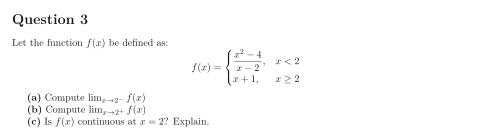
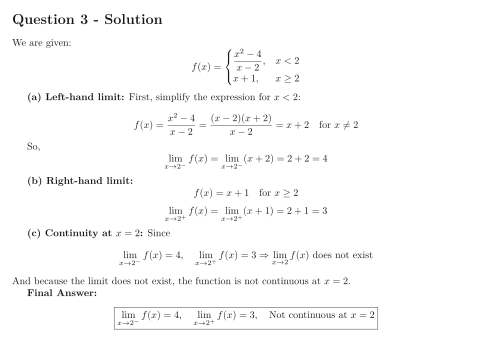
Question 3 Let the function f(x)f(x) be defined as: f(x)={x2−4x−2,x<2x+1,x≥2f(x) = \begin{cases} \dfrac{x^2 - 4}{x - 2}, & x < 2 \\ x + 1, & x \geq 2 \end{cases} (a) Compute limx→2−f(x)\lim_{x \to 2^-} f(x) (b) Compute limx→2+f(x)\lim_{x \to 2^+} f(x) (c) Is f(x)f(x) continuous at x=2x = 2? Explain. Show solutionHide solution+Question 3 - Solution We are given: f(x)={x2−4x−2,x<2x+1,x≥2f(x) = \begin{cases} \dfrac{x^2 - 4}{x - 2}, & x < 2 \\ x + 1, & x \geq 2 \end{cases} (a) Left-hand limit: First, simplify the expression for x<2x < 2: f(x)=x2−4x−2=(x−2)(x+2)x−2=x+2for x≠2f(x) = \frac{x^2 - 4}{x - 2} = \frac{(x - 2)(x + 2)}{x - 2} = x + 2 \quad \text{for } x \neq 2 So, limx→2−f(x)=limx→2−(x+2)=2+2=4\lim_{x \to 2^-} f(x) = \lim_{x \to 2^-} (x + 2) = 2 + 2 = 4 (b) Right-hand limit: f(x)=x+1for x≥2f(x) = x + 1 \quad \text{for } x \geq 2 limx→2+f(x)=limx→2+(x+1)=2+1=3\lim_{x \to 2^+} f(x) = \lim_{x \to 2^+} (x + 1) = 2 + 1 = 3 (c) Continuity at x=2x = 2: Since limx→2−f(x)=4,limx→2+f(x)=3⇒limx→2f(x) does not exist\lim_{x \to 2^-} f(x) = 4, \quad \lim_{x \to 2^+} f(x) = 3 \Rightarrow \lim_{x \to 2} f(x) \text{ does not exist} And because the limit does not exist, the function is not continuous at x=2x = 2. Final Answer: limx→2−f(x)=4,limx→2+f(x)=3,Not continuous at x=2\boxed{ \lim_{x \to 2^-} f(x) = 4, \quad \lim_{x \to 2^+} f(x) = 3, \quad \text{Not continuous at } x = 2 }