The Definition of the Limit — Question 5

PDF ↗

Question 5

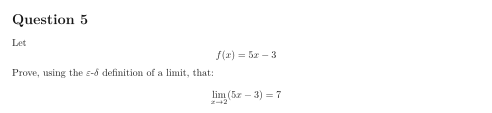
Let f(x)=5x−3f(x) = 5x - 3 Prove, using the ε\varepsilon-δ\delta definition of a limit, that: limx→2(5x−3)=7\lim_{x \to 2} (5x - 3) = 7

Original worksheet page 1: question and worked solution for 2-10-005
Show solutionHide solution

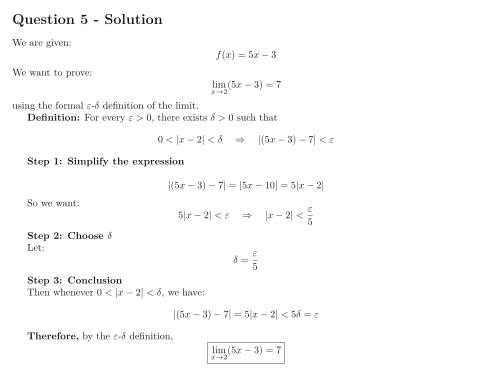
Question 5 - Solution

We are given: f(x)=5x−3f(x) = 5x - 3 We want to prove: limx→2(5x−3)=7\lim_{x \to 2} (5x - 3) = 7 using the formal ε\varepsilon-δ\delta definition of the limit.

Definition: For every ε>0\varepsilon > 0, there exists δ>0\delta > 0 such that 0<|x−2|<δ⇒|(5x−3)−7|<ε0 < |x - 2| < \delta \quad \Rightarrow \quad |(5x - 3) - 7| < \varepsilon

Step 1: Simplify the expression

|(5x−3)−7|=|5x−10|=5|x−2||(5x - 3) - 7| = |5x - 10| = 5|x - 2|

So we want: 5|x−2|<ε⇒|x−2|<ε55|x - 2| < \varepsilon \quad \Rightarrow \quad |x - 2| < \frac{\varepsilon}{5}

Step 2: Choose δ\delta

Let: δ=ε5\delta = \frac{\varepsilon}{5}

Step 3: Conclusion

Then whenever 0<|x−2|<δ0 < |x - 2| < \delta, we have: |(5x−3)−7|=5|x−2|<5δ=ε|(5x - 3) - 7| = 5|x - 2| < 5\delta = \varepsilon

Therefore, by the ε\varepsilon-δ\delta definition, limx→2(5x−3)=7\boxed{\lim_{x \to 2} (5x - 3) = 7}

Original worksheet page 2: question and worked solution for 2-10-005

Original worksheet layout. Use Enlarge or open the PDF for a closer view.