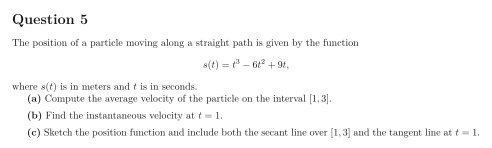
The position of a particle moving along a straight path is given by
the function
where
is in meters and
is in seconds.
(a) Compute the average velocity of the particle on
the interval
.
(b) Find the instantaneous velocity at
.
(c) Sketch the position function and include both
the secant line over
and the tangent line at
.
Show solutionHide solution+
Question 5 -
Solution
Given:
(a) Average velocity on
:
(b) Instantaneous velocity at
:
(c) Interpretation: The particle is momentarily at
rest at
(instantaneous velocity is 0), even though its average velocity between
and
is negative, indicating motion reversal.
See the diagram in the original worksheet below.
Original worksheet layout. Use Enlarge or open the PDF for a closer view.