Solving Trig Equations — Question 8

PDF ↗

Question 8

Solve the equation sin⁡2(x)−cos⁡(x)=0\sin^2(x) - \cos(x) = 0 for all x∈[0,2π]x \in [0, 2\pi].

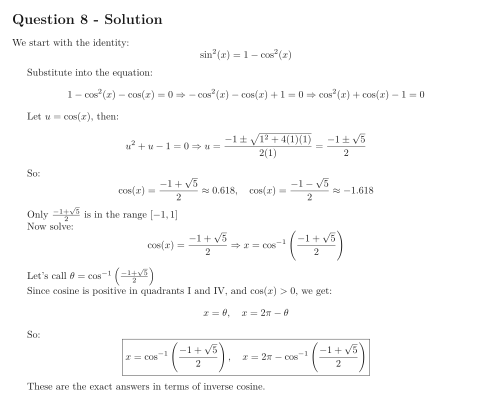
Original worksheet page 1: question and worked solution for 1-4-008
Show solutionHide solution

Question 8 - Solution

We start with the identity: sin⁡2(x)=1−cos⁡2(x)\sin^2(x) = 1 - \cos^2(x)

Substitute into the equation: 1−cos⁡2(x)−cos⁡(x)=0⇒−cos⁡2(x)−cos⁡(x)+1=0⇒cos⁡2(x)+cos⁡(x)−1=01 - \cos^2(x) - \cos(x) = 0 \Rightarrow -\cos^2(x) - \cos(x) + 1 = 0 \Rightarrow \cos^2(x) + \cos(x) - 1 = 0

Let u=cos⁡(x)u = \cos(x), then: u2+u−1=0⇒u=−1±12+4(1)(1)2(1)=−1±52u^2 + u - 1 = 0 \Rightarrow u = \frac{-1 \pm \sqrt{1^2 + 4(1)(1)}}{2(1)} = \frac{-1 \pm \sqrt{5}}{2}

So: cos⁡(x)=−1+52≈0.618,cos⁡(x)=−1−52≈−1.618\cos(x) = \frac{-1 + \sqrt{5}}{2} \approx 0.618,\quad \cos(x) = \frac{-1 - \sqrt{5}}{2} \approx -1.618

Only −1+52\frac{-1 + \sqrt{5}}{2} is in the range [−1,1][-1, 1]

Now solve: cos⁡(x)=−1+52⇒x=cos⁡−1(−1+52)\cos(x) = \frac{-1 + \sqrt{5}}{2} \Rightarrow x = \cos^{-1}\left( \frac{-1 + \sqrt{5}}{2} \right)

Let’s call θ=cos⁡−1(−1+52)\theta = \cos^{-1}\left( \frac{-1 + \sqrt{5}}{2} \right)

Since cosine is positive in quadrants I and IV, and cos⁡(x)>0\cos(x) > 0, we get: x=θ,x=2π−θx = \theta,\quad x = 2\pi - \theta

So: x=cos⁡−1(−1+52),x=2π−cos⁡−1(−1+52)\boxed{ x = \cos^{-1}\left( \frac{-1 + \sqrt{5}}{2} \right),\quad x = 2\pi - \cos^{-1}\left( \frac{-1 + \sqrt{5}}{2} \right) }

These are the exact answers in terms of inverse cosine.

Original worksheet page 2: question and worked solution for 1-4-008

Original worksheet layout. Use Enlarge or open the PDF for a closer view.