Trig Functions — Question 4

PDF ↗

Question 4

Let f(x)=sin⁡(x)cos⁡(x)+cos⁡2(x)f(x) = \sin(x)\cos(x) + \cos^2(x)

  • (a) Express f(x)f(x) in terms of a single trigonometric function or a simpler expression.

  • (b) Find the maximum and minimum values of f(x)f(x) on the interval [0,2π][0, 2\pi].

  • (c) Determine all values of x∈[0,2π]x \in [0, 2\pi] where f(x)=1f(x) = 1.

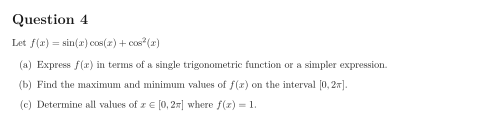
Original worksheet page 1: question and worked solution for 1-3-004
Show solutionHide solution

Question 4 - Solution

Simplify. Double-angle identities give

f(x)=12+22sin⁡(2x+π/4).\boxed{f(x)=\frac12+\frac{\sqrt2}{2}\sin(2x+\pi/4)}.

The sine attains both −1-1 and 11 on the given interval, so

fmin=1−22,fmax=1+22.\boxed{f_{\min}=\frac{1-\sqrt2}{2},\qquad f_{\max}=\frac{1+\sqrt2}{2}}.

Solve without losing roots. Subtracting 11 from the original expression gives

f(x)−1=sin⁡xcos⁡x−sin⁡2x=sin⁡x(cos⁡x−sin⁡x).f(x)-1=\sin x\cos x-\sin^2x=\sin x(\cos x-\sin x).

Thus sin⁡x=0\sin x=0 or cos⁡x=sin⁡x\cos x=\sin x. Restricting both families to [0,2π][0,2\pi] gives

x=0,π/4,π,5π/4,2π.\boxed{x=0,\ \pi/4,\ \pi,\ 5\pi/4,\ 2\pi}.

Each listed value makes one factor zero, so each satisfies the original equation.
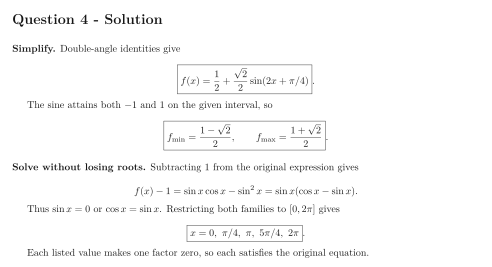
Original worksheet page 2: question and worked solution for 1-3-004

Original worksheet layout. Use Enlarge or open the PDF for a closer view.