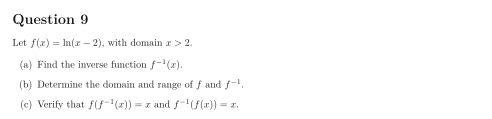
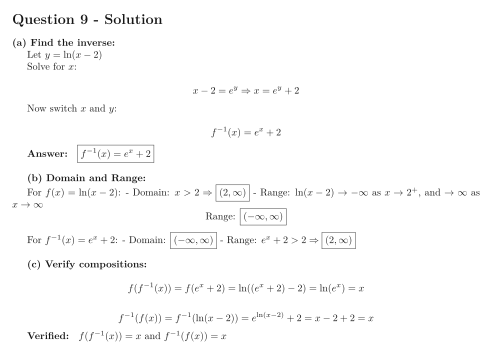
Question 9 Let f(x)=ln(x−2)f(x) = \ln(x - 2), with domain x>2x > 2. (a) Find the inverse function f−1(x)f^{-1}(x). (b) Determine the domain and range of ff and f−1f^{-1}. (c) Verify that f(f−1(x))=xf(f^{-1}(x)) = x and f−1(f(x))=xf^{-1}(f(x)) = x. Show solutionHide solution+Question 9 - Solution (a) Find the inverse: Let y=ln(x−2)y = \ln(x - 2) Solve for xx: x−2=ey⇒x=ey+2x - 2 = e^y \Rightarrow x = e^y + 2 Now switch xx and yy: f−1(x)=ex+2f^{-1}(x) = e^x + 2 Answer: f−1(x)=ex+2\boxed{f^{-1}(x) = e^x + 2} (b) Domain and Range: For f(x)=ln(x−2)f(x) = \ln(x - 2): - Domain: x>2⇒(2,∞)x > 2 \Rightarrow \boxed{(2, \infty)} - Range: ln(x−2)→−∞\ln(x - 2) \to -\infty as x→2+x \to 2^+, and →∞\to \infty as x→∞x \to \infty Range: (−∞,∞)\text{Range: } \boxed{(-\infty, \infty)} For f−1(x)=ex+2f^{-1}(x) = e^x + 2: - Domain: (−∞,∞)\boxed{(-\infty, \infty)} - Range: ex+2>2⇒(2,∞)e^x + 2 > 2 \Rightarrow \boxed{(2, \infty)} (c) Verify compositions: f(f−1(x))=f(ex+2)=ln((ex+2)−2)=ln(ex)=xf(f^{-1}(x)) = f(e^x + 2) = \ln((e^x + 2) - 2) = \ln(e^x) = x f−1(f(x))=f−1(ln(x−2))=eln(x−2)+2=x−2+2=xf^{-1}(f(x)) = f^{-1}(\ln(x - 2)) = e^{\ln(x - 2)} + 2 = x - 2 + 2 = x Verified: f(f−1(x))=xf(f^{-1}(x)) = x and f−1(f(x))=xf^{-1}(f(x)) = x