Question 4
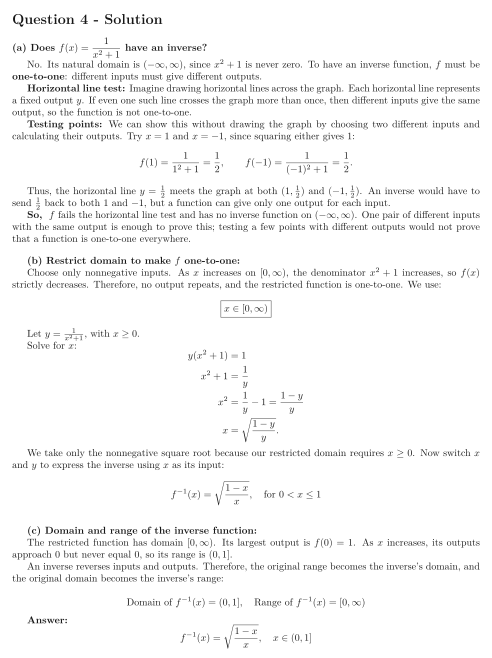
Suppose .
(a) Determine whether has an inverse function. Justify.
(b) If not, restrict the domain of so that it becomes one-to-one and then find the inverse on that restricted domain.
(c) State the domain and range of the inverse function you found.
Show solutionHide solution
Question 4 - Solution
(a) Does have an inverse?
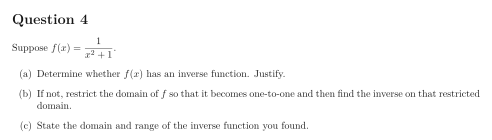
No. Its natural domain is , since is never zero. To have an inverse function, must be one-to-one: different inputs must give different outputs.
Horizontal line test: Imagine drawing horizontal lines across the graph. Each horizontal line represents a fixed output . If even one such line crosses the graph more than once, then different inputs give the same output, so the function is not one-to-one.
Testing points: We can show this without drawing the graph by choosing two different inputs and calculating their outputs. Try and , since squaring either gives :
Thus, the horizontal line meets the graph at both and . An inverse would have to send back to both and , but a function can give only one output for each input.
So, fails the horizontal line test and has no inverse function on . One pair of different inputs with the same output is enough to prove this; testing a few points with different outputs would not prove that a function is one-to-one everywhere.
(b) Restrict domain to make one-to-one:
Choose only nonnegative inputs. As increases on , the denominator increases, so strictly decreases. Therefore, no output repeats, and the restricted function is one-to-one. We use:
Let , with .
Solve for :
We take only the nonnegative square root because our restricted domain requires . Now switch and to express the inverse using as its input:
(c) Domain and range of the inverse function:
The restricted function has domain . Its largest output is . As increases, its outputs approach but never equal , so its range is .
An inverse reverses inputs and outputs. Therefore, the original range becomes the inverse’s domain, and the original domain becomes the inverse’s range:
Answer: