Functions — Question 5

PDF ↗

Question 5

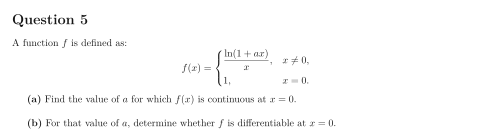
A function ff is defined as: f(x)={ln⁡(1+ax)x,x≠0,1,x=0.f(x) = \begin{cases} \dfrac{\ln(1 + ax)}{x}, & x \neq 0, \\[0.6em] 1, & x = 0. \end{cases}

(a) Find the value of aa for which f(x)f(x) is continuous at x=0x = 0.

(b) For that value of aa, determine whether ff is differentiable at x=0x = 0.

Original worksheet page 1: question and worked solution for 1-1-005
Show solutionHide solution

Question 5 - Solution

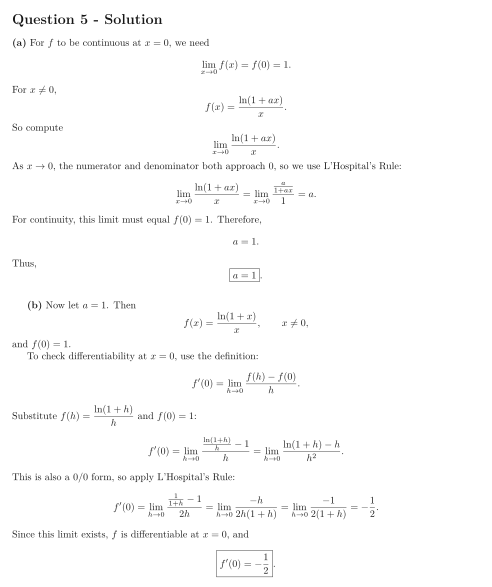
(a) For ff to be continuous at x=0x=0, we need limx→0f(x)=f(0)=1.\lim_{x\to 0} f(x)=f(0)=1. For x≠0x\neq 0, f(x)=ln⁡(1+ax)x.f(x)=\frac{\ln(1+ax)}{x}. So compute limx→0ln⁡(1+ax)x.\lim_{x\to 0}\frac{\ln(1+ax)}{x}. As x→0x\to 0, the numerator and denominator both approach 00, so we use L’Hospital’s Rule: limx→0ln⁡(1+ax)x=limx→0a1+ax1=a.\lim_{x\to 0}\frac{\ln(1+ax)}{x} = \lim_{x\to 0}\frac{\frac{a}{1+ax}}{1} = a. For continuity, this limit must equal f(0)=1f(0)=1. Therefore, a=1.a=1. Thus, a=1.\boxed{a=1}.

(b) Now let a=1a=1. Then f(x)=ln⁡(1+x)x,x≠0,f(x)=\frac{\ln(1+x)}{x}, \qquad x\neq 0, and f(0)=1f(0)=1.

To check differentiability at x=0x=0, use the definition: f′(0)=limh→0f(h)−f(0)h.f'(0)=\lim_{h\to 0}\frac{f(h)-f(0)}{h}. Substitute f(h)=ln⁡(1+h)hf(h)=\dfrac{\ln(1+h)}{h} and f(0)=1f(0)=1: f′(0)=limh→0ln⁡(1+h)h−1h=limh→0ln⁡(1+h)−hh2.f'(0) = \lim_{h\to 0} \frac{\frac{\ln(1+h)}{h}-1}{h} = \lim_{h\to 0} \frac{\ln(1+h)-h}{h^2}. This is also a 0/00/0 form, so apply L’Hospital’s Rule: f′(0)=limh→011+h−12h=limh→0−h2h(1+h)=limh→0−12(1+h)=−12.f'(0) = \lim_{h\to 0} \frac{\frac{1}{1+h}-1}{2h} = \lim_{h\to 0} \frac{-h}{2h(1+h)} = \lim_{h\to 0} \frac{-1}{2(1+h)} = -\frac{1}{2}. Since this limit exists, ff is differentiable at x=0x=0, and f′(0)=−12.\boxed{f'(0)=-\frac{1}{2}}.

Original worksheet page 2: question and worked solution for 1-1-005

Original worksheet layout. Use Enlarge or open the PDF for a closer view.