Question 10
Let on , where . Use it as initial displacement for zero-endpoint heat and wave problems , , with zero initial wave velocity. Also use it as the top trace of a harmonic rectangle of height , with zero side and bottom values. In each field retain modes , .
Tasks
Write the three complete expansions and justify the original data and the relevant convergence claims.
Derive uniform truncation bounds for heat at , for the wave at all times, and for the harmonic field at , .
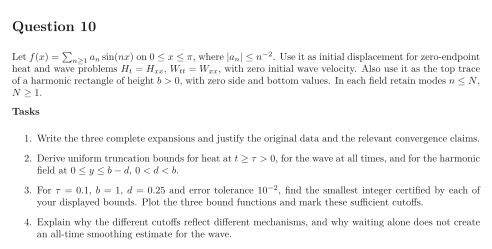
For , , and error tolerance , find the smallest integer certified by each of your displayed bounds. Plot the three bound functions and mark these sufficient cutoffs.
Explain why the different cutoffs reflect different mechanisms, and why waiting alone does not create an all-time smoothing estimate for the wave.
Show solutionHide solution
Question 10 – Solution
Strategy. Apply the same coefficient envelope to three different modal factors, keeping the location where each error bound is valid.
Step 1: Construct the fields and their traces. The three factors give The summable coefficient envelope ensures uniform displacement and boundary-series convergence. Heat derivatives converge away from , and harmonic derivatives away from the top edge. The wave has finite energy since ; its data and PDE have the corresponding energy/weak meaning without an automatic higher-smoothness claim.
Step 2: Bound the three tails. Using gives For , write the hyperbolic ratio as . It is at most , so These respectively bound the heat error for , the wave displacement error at all times, and the harmonic error in the stated lower strip.
Step 3: Choose certified integer cutoffs. Each bound decreases with . With the specified parameters, These are the smallest integers certified by these bounds, not necessarily the fewest modes required by particular data. The graph uses continuous bound envelopes on logarithmic axes.
Step 4: Interpret the filtering mechanisms. Heat damps high modes by ; distance from the driven harmonic edge gives spatial attenuation of order . Wave modes retain their amplitudes and only oscillate: at every , the entire displacement returns to . Consequently waiting cannot supply a uniform future decay factor for every wave tail. The heat and harmonic improvements require positive waiting time or positive distance; they cannot be silently extended to or to the top trace.
See the diagram in the original worksheet below.