Question 1
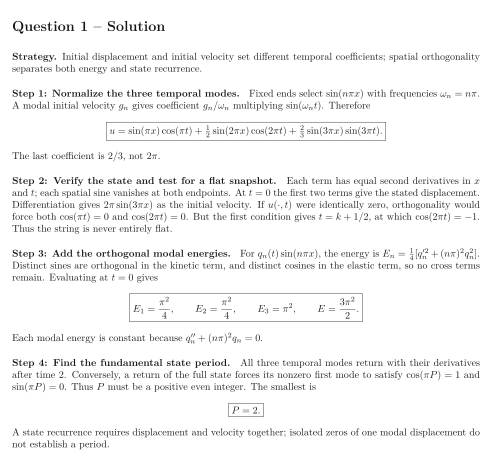
A string on has unit tension and unit mass per length, fixed endpoints, and initial data Its energy is .
Tasks
Construct the complete modal solution, including the correct coefficient of the velocity-generated mode.
Verify the PDE, both endpoint conditions and both initial data. Determine whether the entire string can ever have zero displacement.
Compute the energy carried by each active mode and the total energy. Explain why cross terms do not contribute.
Find the smallest positive period of the full state . Prove minimality rather than merely giving a return time.
Show solutionHide solution
Question 1 – Solution
Strategy. Initial displacement and initial velocity set different temporal coefficients; spatial orthogonality separates both energy and state recurrence.
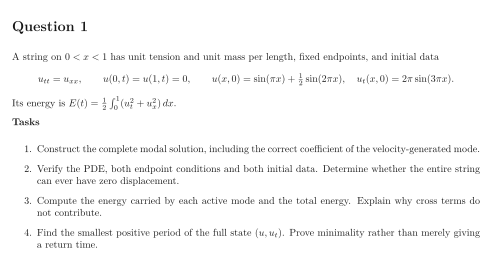
Step 1: Normalize the three temporal modes. Fixed ends select with frequencies . A modal initial velocity gives coefficient multiplying . Therefore The last coefficient is , not .
Step 2: Verify the state and test for a flat snapshot. Each term has equal second derivatives in and ; each spatial sine vanishes at both endpoints. At the first two terms give the stated displacement. Differentiation gives as the initial velocity. If were identically zero, orthogonality would force both and . But the first condition gives , at which . Thus the string is never entirely flat.
Step 3: Add the orthogonal modal energies. For , the energy is . Distinct sines are orthogonal in the kinetic term, and distinct cosines in the elastic term, so no cross terms remain. Evaluating at gives Each modal energy is constant because .
Step 4: Find the fundamental state period. All three temporal modes return with their derivatives after time . Conversely, a return of the full state forces its nonzero first mode to satisfy and . Thus must be a positive even integer. The smallest is A state recurrence requires displacement and velocity together; isolated zeros of one modal displacement do not establish a period.