Question 10
Let be harmonic on the unit square , continuous on its closure, with prescribed boundary values . A proposed approximation is twice continuously differentiable on the closed square and satisfies You may use the weak maximum principle for subharmonic functions: if , then .
Tasks
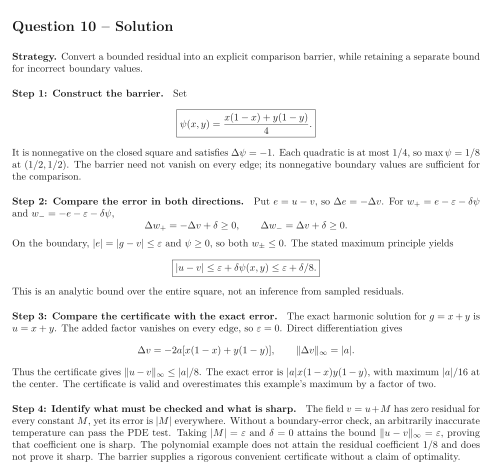
Construct a quadratic nonnegative barrier with and maximum on the square.
Prove . Check the signs of both comparison functions.
Test the estimate for and , where . Determine the exact boundary error, residual bound and actual maximum error, and compare with the certificate.
Explain why checking only the PDE residual cannot certify the answer. Show that the coefficient of in the estimate is sharp, and state whether this example proves sharpness of .
Show solutionHide solution
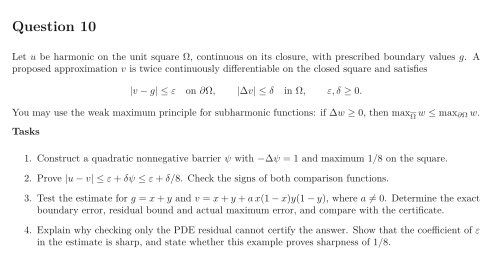
Question 10 – Solution
Strategy. Convert a bounded residual into an explicit comparison barrier, while retaining a separate bound for incorrect boundary values.
Step 1: Construct the barrier. Set It is nonnegative on the closed square and satisfies . Each quadratic is at most , so at . The barrier need not vanish on every edge; its nonnegative boundary values are sufficient for the comparison.
Step 2: Compare the error in both directions. Put , so . For and , On the boundary, and , so both . The stated maximum principle yields This is an analytic bound over the entire square, not an inference from sampled residuals.
Step 3: Compare the certificate with the exact error. The exact harmonic solution for is . The added factor vanishes on every edge, so . Direct differentiation gives Thus the certificate gives . The exact error is , with maximum at the center. The certificate is valid and overestimates this example’s maximum by a factor of two.
Step 4: Identify what must be checked and what is sharp. The field has zero residual for every constant , yet its error is everywhere. Without a boundary-error check, an arbitrarily inaccurate temperature can pass the PDE test. Taking and attains the bound , proving that coefficient one is sharp. The polynomial example does not attain the residual coefficient and does not prove it sharp. The barrier supplies a rigorous convenient certificate without a claim of optimality.