Question 8
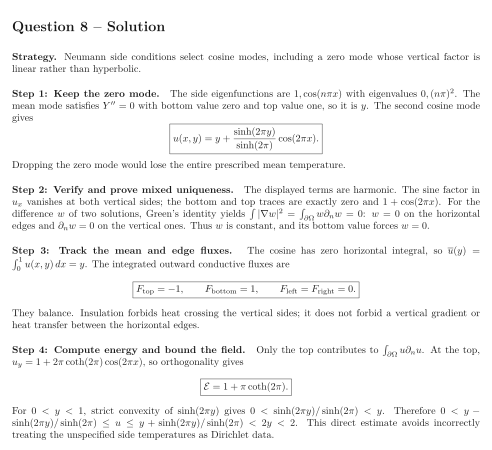
A unit square has insulated vertical sides and prescribed horizontal temperatures: Seek a solution smooth up to the boundary. Conductivity is one.
Tasks
Construct the solution by separation, treating the zero spatial eigenvalue explicitly.
Verify every datum and prove uniqueness for this mixed boundary problem using Green’s identity.
Compute the horizontal average at each height and the integrated outward heat flux on each edge. Explain why zero side flux does not force constant temperature.
Calculate the Dirichlet energy. Prove at every interior point, justifying how the insulated sides are handled.
Show solutionHide solution
Question 8 – Solution
Strategy. Neumann side conditions select cosine modes, including a zero mode whose vertical factor is linear rather than hyperbolic.
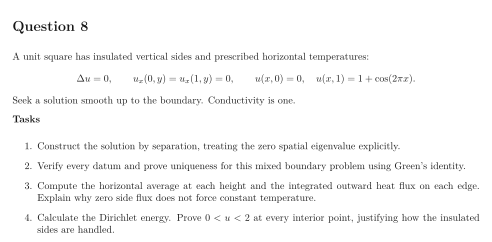
Step 1: Keep the zero mode. The side eigenfunctions are with eigenvalues . The mean mode satisfies with bottom value zero and top value one, so it is . The second cosine mode gives Dropping the zero mode would lose the entire prescribed mean temperature.
Step 2: Verify and prove mixed uniqueness. The displayed terms are harmonic. The sine factor in vanishes at both vertical sides; the bottom and top traces are exactly zero and . For the difference of two solutions, Green’s identity yields : on the horizontal edges and on the vertical ones. Thus is constant, and its bottom value forces .
Step 3: Track the mean and edge fluxes. The cosine has zero horizontal integral, so . The integrated outward conductive fluxes are They balance. Insulation forbids heat crossing the vertical sides; it does not forbid a vertical gradient or heat transfer between the horizontal edges.
Step 4: Compute energy and bound the field. Only the top contributes to . At the top, , so orthogonality gives For , strict convexity of gives . Therefore . This direct estimate avoids incorrectly treating the unspecified side temperatures as Dirichlet data.