Question 5
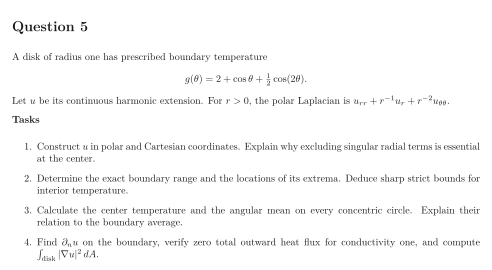
A disk of radius one has prescribed boundary temperature Let be its continuous harmonic extension. For , the polar Laplacian is .
Tasks
Construct in polar and Cartesian coordinates. Explain why excluding singular radial terms is essential at the center.
Determine the exact boundary range and the locations of its extrema. Deduce sharp strict bounds for interior temperature.
Calculate the center temperature and the angular mean on every concentric circle. Explain their relation to the boundary average.
Find on the boundary, verify zero total outward heat flux for conductivity one, and compute .
Show solutionHide solution
Question 5 – Solution
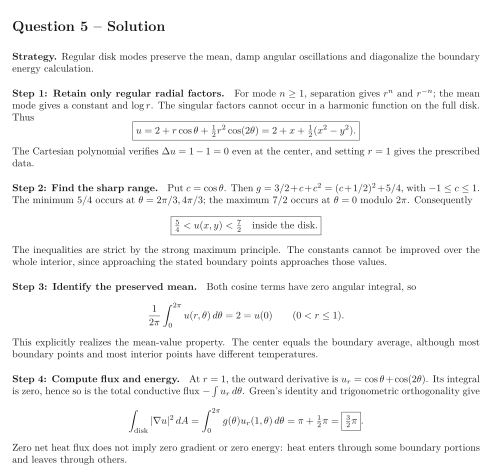
Strategy. Regular disk modes preserve the mean, damp angular oscillations and diagonalize the boundary energy calculation.
Step 1: Retain only regular radial factors. For mode , separation gives and ; the mean mode gives a constant and . The singular factors cannot occur in a harmonic function on the full disk. Thus The Cartesian polynomial verifies even at the center, and setting gives the prescribed data.
Step 2: Find the sharp range. Put . Then , with . The minimum occurs at ; the maximum occurs at modulo . Consequently The inequalities are strict by the strong maximum principle. The constants cannot be improved over the whole interior, since approaching the stated boundary points approaches those values.
Step 3: Identify the preserved mean. Both cosine terms have zero angular integral, so This explicitly realizes the mean-value property. The center equals the boundary average, although most boundary points and most interior points have different temperatures.
Step 4: Compute flux and energy. At , the outward derivative is . Its integral is zero, hence so is the total conductive flux . Green’s identity and trigonometric orthogonality give Zero net heat flux does not imply zero gradient or zero energy: heat enters through some boundary portions and leaves through others.