Question 1
A square plate occupies , . Its steady temperature satisfies The conductivity is one, so the outward heat flux is .
Tasks
Construct the harmonic temperature by separation of variables and verify all four boundary values.
At height , determine the attenuation of each boundary mode and their amplitude ratio. Explain which spatial feature penetrates farther into the plate.
Compute the total outward heat flux on each edge and verify global balance. Use outward normals consistently.
Sketch temperature profiles at . Prove that the temperature is strictly positive in the interior despite the sign changes of the third sine mode.
Show solutionHide solution
Question 1 – Solution
Strategy. Separate the two imposed spatial frequencies and track their normal derivatives as well as their temperatures.
Step 1: Extend each boundary mode. The zero side values give ; the corresponding vertical equation is . The bottom value selects and the top value normalizes it: Each term has zero Laplacian. Substitution gives all four traces, including compatible corner values. The maximum principle gives uniqueness among continuous harmonic extensions.
Step 2: Compare penetration of the modes. Since , the first and third modes are attenuated by and . Their third-to-first amplitude ratio is It is smaller than the boundary ratio : the higher spatial frequency loses amplitude faster away from the driven edge.
Step 3: Balance the four edge fluxes. Integrating along each unit edge gives For example, at the bottom the outward normal is , so the outward heat flux is , not . The identity proves that the four totals sum to zero.
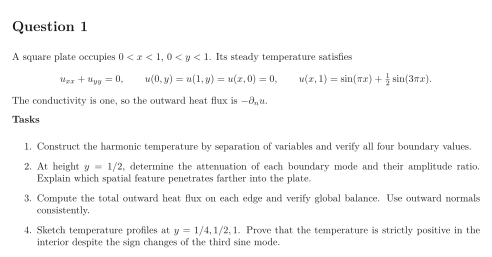
Step 4: Interpret the profiles and their sign. Writing , the top value is , and it is positive for . The weak maximum principle gives ; the strong maximum principle gives inside because the boundary data are not constant. Individual modes need not be positive.
See the diagram in the original worksheet below.