Question 1
Solve for , , with The temperature is measured relative to the zero endpoint temperature.
Tasks
Construct the solution from the initial modes and verify the PDE, both endpoint conditions and the initial trace.
Prove directly from the formula that the initial temperature and every positive-time temperature are nonnegative. Does this force the temperature at every fixed interior point to decrease?
At , determine the initial rate of change and the exact time of the unique temperature maximum. Justify the sign change of the time derivative.
Compute the total heat and its boundary-flux balance. Sketch profiles at and explain how local warming is consistent with net heat loss.
Show solutionHide solution
Question 1 – Solution
Strategy. Different spatial modes decay at different rates; local temperature and total heat need not have the same monotonicity.
Step 1: Evolve each initial mode. Since , the solution is Termwise differentiation of this finite sum gives . Both sines vanish at the endpoints, and setting gives the prescribed field. The formula is smooth on the closed space interval for all .
Step 2: Prove nonnegativity without a plot. Factor the solution as . For and , and the bracket is nonnegative. At positive time the bracket is strictly positive; hence the interior temperature is positive. This sign statement concerns values, not their time derivatives. Diffusion can transport heat into a cooler interior region.
Step 3: Find the local warming interval. At , Thus . Factoring out shows that the derivative changes sign exactly when . The unique maximum occurs at Before the derivative is positive; afterward it is negative. This gives a concrete counterexample to pointwise monotone cooling.
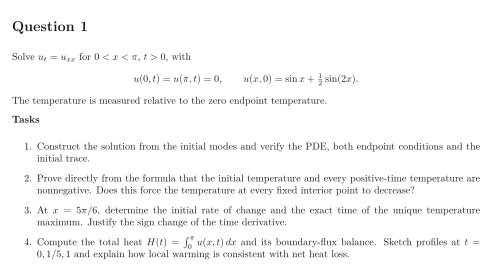
Step 4: Compare with the global heat balance. Integration gives , since the second sine has zero integral. Also , so . The right endpoint derivative minus the left is the signed flux balance obtained by integrating the PDE. Total heat falls even while a neighborhood of initially warms.
See the diagram in the original worksheet below.