Question 2
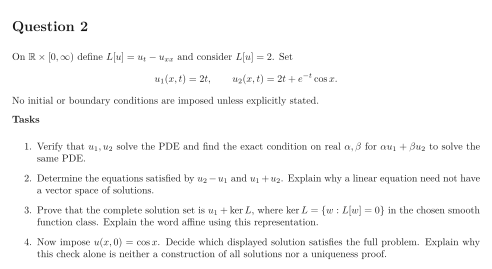
On define and consider . Set No initial or boundary conditions are imposed unless explicitly stated.
Tasks
Verify that solve the PDE and find the exact condition on real for to solve the same PDE.
Determine the equations satisfied by and . Explain why a linear equation need not have a vector space of solutions.
Prove that the complete solution set is , where in the chosen smooth function class. Explain the word affine using this representation.
Now impose . Decide which displayed solution satisfies the full problem. Explain why this check alone is neither a construction of all solutions nor a uniqueness proof.
Show solutionHide solution
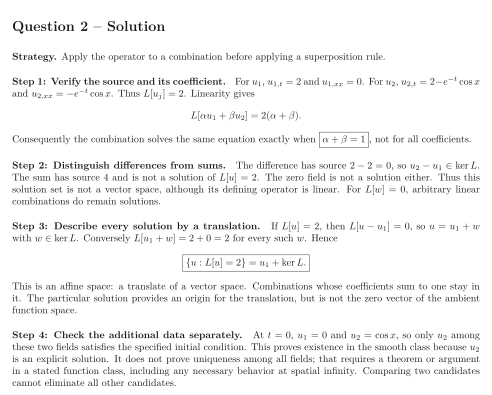
Question 2 – Solution
Strategy. Apply the operator to a combination before applying a superposition rule.
Step 1: Verify the source and its coefficient. For , and . For , and . Thus . Linearity gives Consequently the combination solves the same equation exactly when , not for all coefficients.
Step 2: Distinguish differences from sums. The difference has source , so . The sum has source and is not a solution of . The zero field is not a solution either. Thus this solution set is not a vector space, although its defining operator is linear. For , arbitrary linear combinations do remain solutions.
Step 3: Describe every solution by a translation. If , then , so with . Conversely for every such . Hence This is an affine space: a translate of a vector space. Combinations whose coefficients sum to one stay in it. The particular solution provides an origin for the translation, but is not the zero vector of the ambient function space.
Step 4: Check the additional data separately. At , and , so only among these two fields satisfies the specified initial condition. This proves existence in the smooth class because is an explicit solution. It does not prove uniqueness among all fields; that requires a theorem or argument in a stated function class, including any necessary behavior at spatial infinity. Comparing two candidates cannot eliminate all other candidates.