Question 9
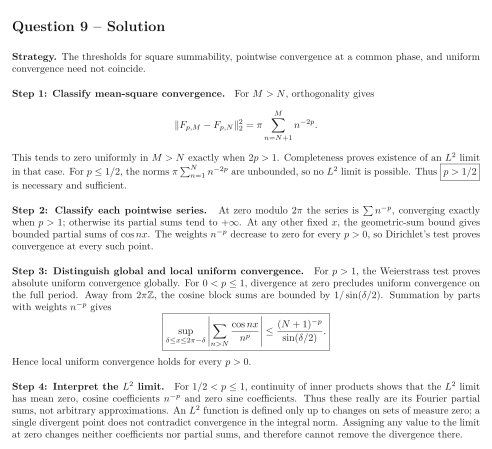
For , study on . You may use completeness of : a Cauchy sequence in its norm has an limit; taking an inner product with any fixed function is continuous. Also use Dirichlet’s test for a scalar series with bounded partial sums multiplied by decreasing positive weights tending to zero.
Tasks
Classify exactly those for which the sequence converges in , proving both directions by orthogonality.
Determine convergence at modulo , and at every other fixed point.
Classify uniform convergence on the full period. Prove uniform convergence on each closed subinterval avoiding for every .
For , explain rigorously how an function can have these Fourier partial sums although they diverge at zero. Can redefining the limit’s value at zero change that divergence?
Show solutionHide solution
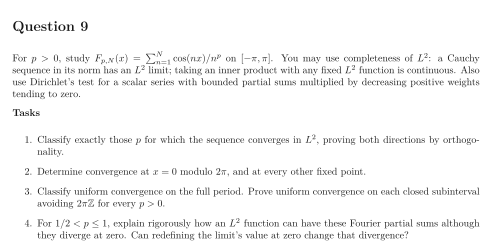
Question 9 – Solution
Strategy. The thresholds for square summability, pointwise convergence at a common phase, and uniform convergence need not coincide.
Step 1: Classify mean-square convergence. For , orthogonality gives This tends to zero uniformly in exactly when . Completeness proves existence of an limit in that case. For , the norms are unbounded, so no limit is possible. Thus is necessary and sufficient.
Step 2: Classify each pointwise series. At zero modulo the series is , converging exactly when ; otherwise its partial sums tend to . At any other fixed , the geometric-sum bound gives bounded partial sums of . The weights decrease to zero for every , so Dirichlet’s test proves convergence at every such point.
Step 3: Distinguish global and local uniform convergence. For , the Weierstrass test proves absolute uniform convergence globally. For , divergence at zero precludes uniform convergence on the full period. Away from , the cosine block sums are bounded by . Summation by parts with weights gives Hence local uniform convergence holds for every .
Step 4: Interpret the limit. For , continuity of inner products shows that the limit has mean zero, cosine coefficients and zero sine coefficients. Thus these really are its Fourier partial sums, not arbitrary approximations. An function is defined only up to changes on sets of measure zero; a single divergent point does not contradict convergence in the integral norm. Assigning any value to the limit at zero changes neither coefficients nor partial sums, and therefore cannot remove the divergence there.