Question 5
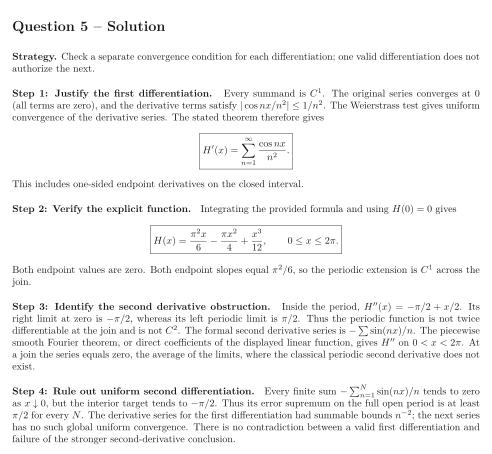
Consider You may use the theorem: if a series of functions converges at one point and its derivative series converges uniformly, its sum is and may be differentiated term by term. Also use
Tasks
Verify every hypothesis needed to differentiate the series once on .
Integrate the given derivative formula to obtain a closed form for . Check the endpoint values and slopes of its periodic extension.
Determine whether the periodic extension is . Identify precisely where the formal second derivative series agrees with the classical second derivative.
Prove that the second derivative partial sums cannot converge uniformly to the interior second derivative on . Explain why the first differentiation remains valid.
Show solutionHide solution
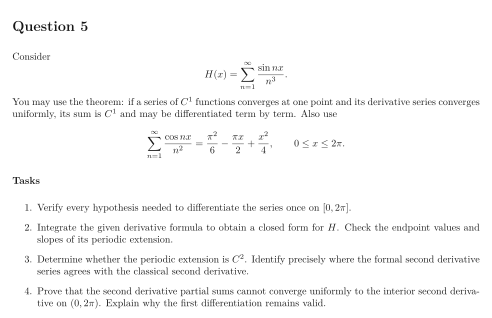
Question 5 – Solution
Strategy. Check a separate convergence condition for each differentiation; one valid differentiation does not authorize the next.
Step 1: Justify the first differentiation. Every summand is . The original series converges at (all terms are zero), and the derivative terms satisfy . The Weierstrass test gives uniform convergence of the derivative series. The stated theorem therefore gives This includes one-sided endpoint derivatives on the closed interval.
Step 2: Verify the explicit function. Integrating the provided formula and using gives Both endpoint values are zero. Both endpoint slopes equal , so the periodic extension is across the join.
Step 3: Identify the second derivative obstruction. Inside the period, . Its right limit at zero is , whereas its left periodic limit is . Thus the periodic function is not twice differentiable at the join and is not . The formal second derivative series is . The piecewise smooth Fourier theorem, or direct coefficients of the displayed linear function, gives on . At a join the series equals zero, the average of the limits, where the classical periodic second derivative does not exist.
Step 4: Rule out uniform second differentiation. Every finite sum tends to zero as , but the interior target tends to . Thus its error supremum on the full open period is at least for every . The derivative series for the first differentiation had summable bounds ; the next series has no such global uniform convergence. There is no contradiction between a valid first differentiation and failure of the stronger second-derivative conclusion.