Question 8
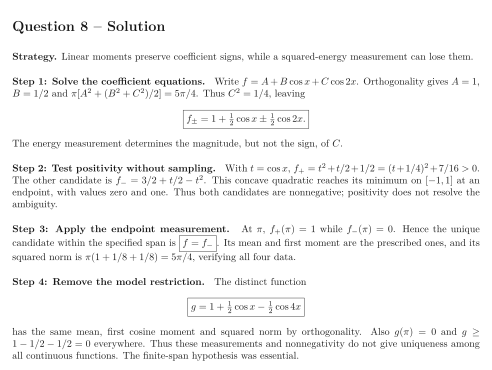
Initially is known to lie in on . Measurements give There is also a requirement .
Tasks
Recover all functions in the stated span satisfying the measurements. Identify where a sign ambiguity enters.
Decide whether nonnegativity eliminates either candidate. Prove the answer on the entire interval using .
A fourth measurement is . Find the unique candidate in the stated span and verify all the data.
Remove the restriction to that span. Construct another nonnegative continuous function with all four measurements, and explain the limitation of the earlier uniqueness result.
Show solutionHide solution
Question 8 – Solution
Strategy. Linear moments preserve coefficient signs, while a squared-energy measurement can lose them.
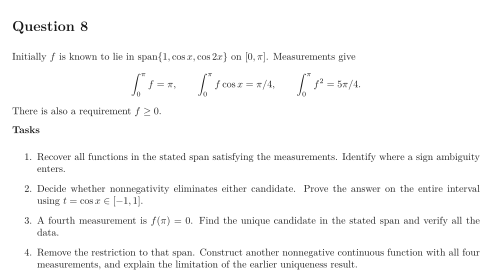
Step 1: Solve the coefficient equations. Write . Orthogonality gives , and . Thus , leaving The energy measurement determines the magnitude, but not the sign, of .
Step 2: Test positivity without sampling. With , . The other candidate is . This concave quadratic reaches its minimum on at an endpoint, with values zero and one. Thus both candidates are nonnegative; positivity does not resolve the ambiguity.
Step 3: Apply the endpoint measurement. At , while . Hence the unique candidate within the specified span is . Its mean and first moment are the prescribed ones, and its squared norm is , verifying all four data.
Step 4: Remove the model restriction. The distinct function has the same mean, first cosine moment and squared norm by orthogonality. Also and everywhere. Thus these measurements and nonnegativity do not give uniqueness among all continuous functions. The finite-span hypothesis was essential.