Question 9
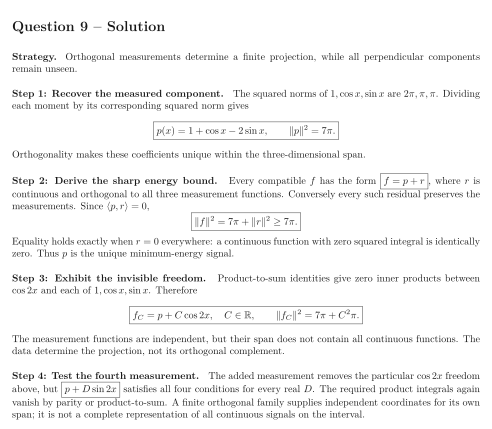
A continuous signal on is known only through three moments: Use the ordinary integral inner product. The three measurement functions are mutually orthogonal.
Tasks
Find the unique function in their span that matches all three measurements. Compute its squared norm.
Characterize every continuous signal with those measurements as a determined part plus an undetermined residual. Prove a sharp lower bound for and characterize equality.
Exhibit infinitely many distinct compatible signals explicitly, and compute their squared norms. Explain why linear independence of the measurement functions does not imply recovery of an arbitrary signal.
Suppose a fourth measurement gives . Does that make the signal unique? Give an explicit counterexample and distinguish a finite orthogonal family from a complete representation.
Show solutionHide solution
Question 9 – Solution
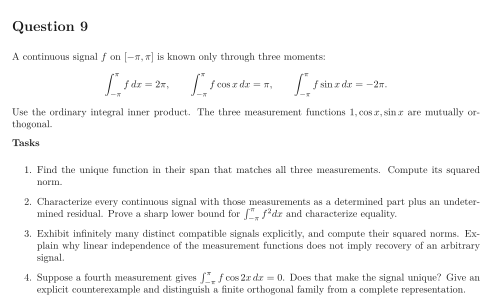
Strategy. Orthogonal measurements determine a finite projection, while all perpendicular components remain unseen.
Step 1: Recover the measured component. The squared norms of are . Dividing each moment by its corresponding squared norm gives Orthogonality makes these coefficients unique within the three-dimensional span.
Step 2: Derive the sharp energy bound. Every compatible has the form , where is continuous and orthogonal to all three measurement functions. Conversely every such residual preserves the measurements. Since , Equality holds exactly when everywhere: a continuous function with zero squared integral is identically zero. Thus is the unique minimum-energy signal.
Step 3: Exhibit the invisible freedom. Product-to-sum identities give zero inner products between and each of . Therefore The measurement functions are independent, but their span does not contain all continuous functions. The data determine the projection, not its orthogonal complement.
Step 4: Test the fourth measurement. The added measurement removes the particular freedom above, but satisfies all four conditions for every real . The required product integrals again vanish by parity or product-to-sum. A finite orthogonal family supplies independent coordinates for its own span; it is not a complete representation of all continuous signals on the interval.