Question 1
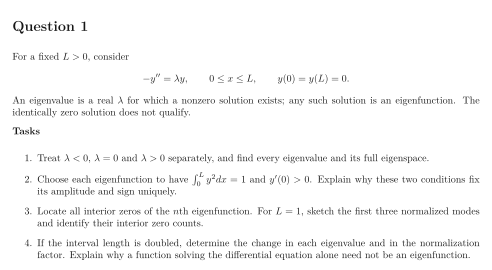
For a fixed , consider An eigenvalue is a real for which a nonzero solution exists; any such solution is an eigenfunction. The identically zero solution does not qualify.
Tasks
Treat , and separately, and find every eigenvalue and its full eigenspace.
Choose each eigenfunction to have and . Explain why these two conditions fix its amplitude and sign uniquely.
Locate all interior zeros of the th eigenfunction. For , sketch the first three normalized modes and identify their interior zero counts.
If the interval length is doubled, determine the change in each eigenvalue and in the normalization factor. Explain why a function solving the differential equation alone need not be an eigenfunction.
Show solutionHide solution
Question 1 – Solution
Strategy. Enforce both homogeneous endpoint conditions in each sign case before normalizing a nonzero solution.
Step 1: Classify all real parameters. For , gives ; since , the right condition forces . For , the left condition gives and the right gives . For , , so a nonzero requires . Thus
Step 2: Fix amplitude and sign. The identity gives . The unit norm requires , and selects the positive sign:
Step 3: Count the interior zeros. The zeros are , , of which exactly lie inside. They are simple because the derivative there is nonzero. The first three modes on the unit interval therefore have zero, one and two interior zeros.
Step 4: Rescale the interval. Replacing by divides each eigenvalue by four and the normalization factor by . For example, solves the differential equation with but fails the left endpoint condition. The equation, both boundary conditions and nontriviality are all part of the eigenproblem.
See the diagram in the original worksheet below.
