Question 9
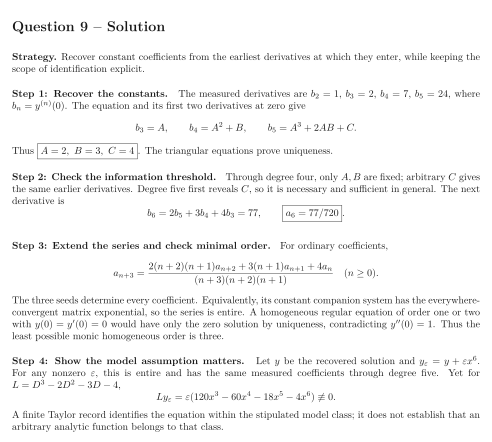
A solution is known to satisfy a constant-coefficient homogeneous equation where are unknown real constants. Its measured Taylor expansion is
Tasks
Convert the measured coefficients into derivatives and recover uniquely. Show the triangular recovery equations.
Explain why degree five is the lowest Taylor degree that suffices in general. Predict the coefficient of from the recovered equation.
Derive the full coefficient recurrence and justify that it determines an entire solution with the given data. Rule out any lower-order monic constant-coefficient homogeneous equation for this same solution.
Explain why the stated model assumption is essential. Construct analytic functions with the same measured expansion through degree five that do not solve the recovered equation.
Show solutionHide solution
Question 9 – Solution
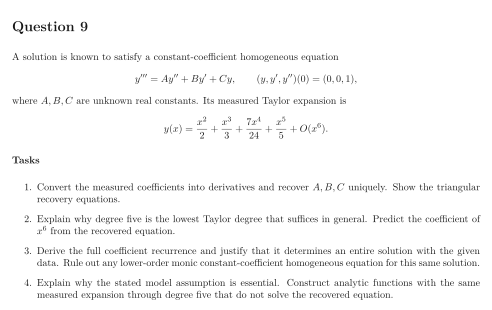
Strategy. Recover constant coefficients from the earliest derivatives at which they enter, while keeping the scope of identification explicit.
Step 1: Recover the constants. The measured derivatives are , , , , where . The equation and its first two derivatives at zero give Thus . The triangular equations prove uniqueness.
Step 2: Check the information threshold. Through degree four, only are fixed; arbitrary gives the same earlier derivatives. Degree five first reveals , so it is necessary and sufficient in general. The next derivative is
Step 3: Extend the series and check minimal order. For ordinary coefficients, The three seeds determine every coefficient. Equivalently, its constant companion system has the everywhere-convergent matrix exponential, so the series is entire. A homogeneous regular equation of order one or two with would have only the zero solution by uniqueness, contradicting . Thus the least possible monic homogeneous order is three.
Step 4: Show the model assumption matters. Let be the recovered solution and . For any nonzero , this is entire and has the same measured coefficients through degree five. Yet for , A finite Taylor record identifies the equation within the stipulated model class; it does not establish that an arbitrary analytic function belongs to that class.