Question 7
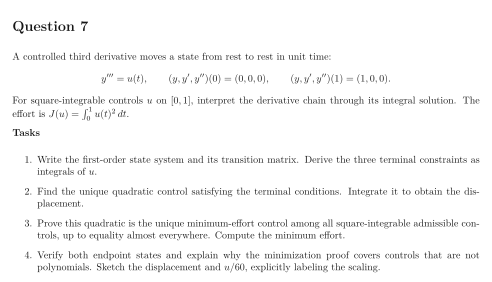
A controlled third derivative moves a state from rest to rest in unit time: For square-integrable controls on , interpret the derivative chain through its integral solution. The effort is .
Tasks
Write the first-order state system and its transition matrix. Derive the three terminal constraints as integrals of .
Find the unique quadratic control satisfying the terminal conditions. Integrate it to obtain the displacement.
Prove this quadratic is the unique minimum-effort control among all square-integrable admissible controls, up to equality almost everywhere. Compute the minimum effort.
Verify both endpoint states and explain why the minimization proof covers controls that are not polynomials. Sketch the displacement and , explicitly labeling the scaling.
Show solutionHide solution
Question 7 – Solution
Strategy. Express the terminal state as three moments, then use orthogonality to prove optimality over the full control class.
Step 1: Derive the terminal moments. For , , where has ones just above the diagonal and zeros elsewhere. Since , The required three moments are .
Step 2: Solve within the quadratic space. For , the constraints are Their solution is The moment kernels span all quadratics. A quadratic in the homogeneous null space is orthogonal to itself and hence zero, proving uniqueness here.
Step 3: Prove global minimum effort. For any admissible , all three terminal moments of vanish. Because is in their span, . Therefore Equality holds exactly when almost everywhere. This argument only uses square integrability and moment constraints, not polynomial form for .
Step 4: Verify the endpoint motion. We have and , so the two endpoint states are exactly and ; differentiating again gives . The graph uses so the control and displacement are both readable.
See the diagram in the original worksheet below.
