Question 6
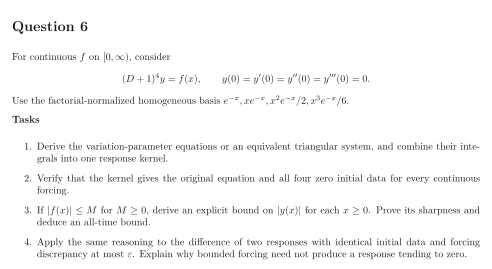
For continuous on , consider Use the factorial-normalized homogeneous basis .
Tasks
Derive the variation-parameter equations or an equivalent triangular system, and combine their integrals into one response kernel.
Verify that the kernel gives the original equation and all four zero initial data for every continuous forcing.
If for , derive an explicit bound on for each . Prove its sharpness and deduce an all-time bound.
Apply the same reasoning to the difference of two responses with identical initial data and forcing discrepancy at most . Explain why bounded forcing need not produce a response tending to zero.
Show solutionHide solution
Question 6 – Solution
Strategy. Use the repeated-root basis to produce a positive kernel whose integral is explicit.
Step 1: Solve the shifted parameter system. Write . The equation becomes . The original basis becomes for , with parameter derivatives The homogeneous basis is fundamental: its Wronskian is . Integrating from zero gives
Step 2: Verify the response kernel. The function satisfies for , and , . Repeated Leibniz differentiation therefore adds no endpoint terms until the fourth derivative, where it adds exactly . Combining derivatives in cancels the integral terms. All four initial data vanish because the relevant integrals have zero length.
Step 3: Integrate the positive kernel sharply. For , . Repeated integration by parts yields Consequently, The forcing gives and attains the pointwise bound. Also , so no smaller all-time constant than works for all admissible forcings when . The case gives the zero solution.
Step 4: Bound input error without claiming decay. For identical initial data, the response difference has zero initial vector and forcing difference bounded by . Thus . But gives , not zero. A positive integrable kernel controls size; it does not force the output to vanish for a persistent input.
See the diagram in the original worksheet below.
