Question 2
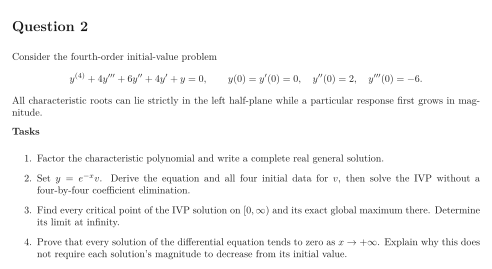
Consider the fourth-order initial-value problem All characteristic roots can lie strictly in the left half-plane while a particular response first grows in magnitude.
Tasks
Factor the characteristic polynomial and write a complete real general solution.
Set . Derive the equation and all four initial data for , then solve the IVP without a four-by-four coefficient elimination.
Find every critical point of the IVP solution on and its exact global maximum there. Determine its limit at infinity.
Prove that every solution of the differential equation tends to zero as . Explain why this does not require each solution’s magnitude to decrease from its initial value.
Show solutionHide solution
Question 2 – Solution
Strategy. Remove the repeated exponential factor, then analyze the resulting polynomial times exponential.
Step 1: Include the entire repeated-root chain. The polynomial is , so Four distinct powers are needed for a root of multiplicity four.
Step 2: Transfer the initial derivatives. Since , four applications give . Also , so the product rule gives Therefore and . Its initial value and first three derivatives are as required; the shift identity verifies the equation.
Step 3: Locate the transient maximum. Here . It vanishes at and , is positive on and negative on . Thus The endpoint is a zero of the derivative and a minimum on the half-line.
Step 4: Separate eventual decay from monotonicity. Each , , tends to zero; hence every linear combination does too. Decay at infinity is an asymptotic statement. This IVP solution starts at zero and increases before decreasing, so neither its value nor its magnitude must decrease throughout the half-line.
See the diagram in the original worksheet below.
