Question 5
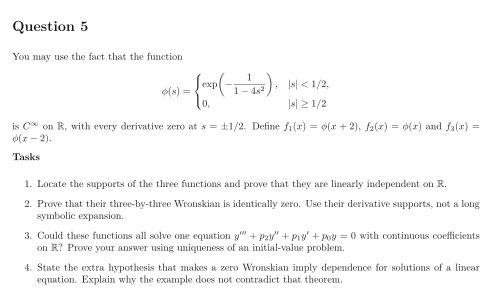
You may use the fact that the function is on , with every derivative zero at . Define , and .
Tasks
Locate the supports of the three functions and prove that they are linearly independent on .
Prove that their three-by-three Wronskian is identically zero. Use their derivative supports, not a long symbolic expansion.
Could these functions all solve one equation with continuous coefficients on ? Prove your answer using uniqueness of an initial-value problem.
State the extra hypothesis that makes a zero Wronskian imply dependence for solutions of a linear equation. Explain why the example does not contradict that theorem.
Show solutionHide solution
Question 5 – Solution
Strategy. Compare independence of arbitrary smooth functions with independence inside one regular homogeneous solution space.
Step 1: Prove independence by separated values. The supports are , and , respectively. They are disjoint, and each function has value at its center . If identically, evaluation at those three centers gives . The functions are therefore linearly independent.
Step 2: Compute the determinant structurally. Outside a function’s support, it and its derivatives vanish; at the support boundary, the supplied smoothness facts give the same conclusion. At every , at most one column of can be nonzero. Thus .
Step 3: Test the common-equation hypothesis. Suppose all three solved the stated regular homogeneous equation. The function has . The zero solution has the same data, so uniqueness on would force . But , a contradiction. Such continuous coefficients cannot exist.
Step 4: State the theorem with its hypotheses. For three solutions of the same normalized third-order homogeneous linear equation with continuous coefficients on a connected interval, a zero Wronskian at one point gives a nonzero coefficient combination with zero initial derivative vector. Uniqueness then makes that combination identically zero, proving dependence. Our functions are arbitrary smooth functions, not solutions of one such equation. Their identically zero Wronskian alone therefore does not imply dependence.
See the diagram in the original worksheet below.
