Question 8
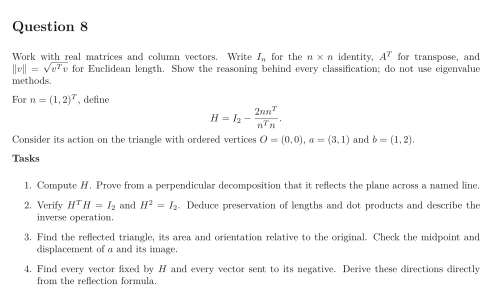
Work with real matrices and column vectors. Write for the identity, for transpose, and for Euclidean length. Show the reasoning behind every classification; do not use eigenvalue methods.
For , define Consider its action on the triangle with ordered vertices , and .
Tasks
Compute . Prove from a perpendicular decomposition that it reflects the plane across a named line.
Verify and . Deduce preservation of lengths and dot products and describe the inverse operation.
Find the reflected triangle, its area and orientation relative to the original. Check the midpoint and displacement of and its image.
Find every vector fixed by and every vector sent to its negative. Derive these directions directly from the reflection formula.
Show solutionHide solution
Question 8 – Solution
Strategy. Separate a vector into components parallel and perpendicular to the normal. The formula changes the sign of only the normal component.
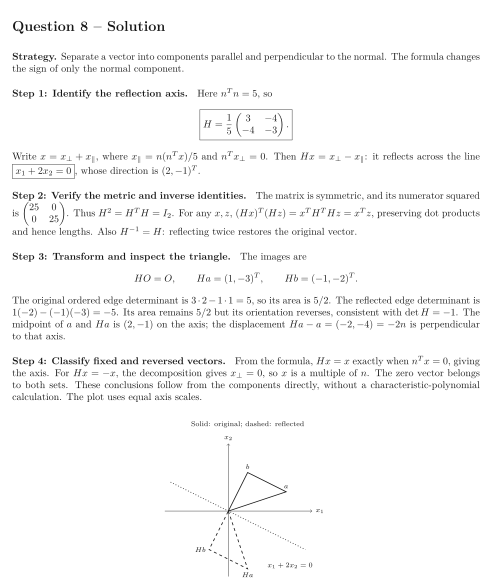
Step 1: Identify the reflection axis. Here , so Write , where and . Then : it reflects across the line , whose direction is .
Step 2: Verify the metric and inverse identities. The matrix is symmetric, and its numerator squared is . Thus . For any , , preserving dot products and hence lengths. Also : reflecting twice restores the original vector.
Step 3: Transform and inspect the triangle. The images are The original ordered edge determinant is , so its area is . The reflected edge determinant is . Its area remains but its orientation reverses, consistent with . The midpoint of and is on the axis; the displacement is perpendicular to that axis.
Step 4: Classify fixed and reversed vectors. From the formula, exactly when , giving the axis. For , the decomposition gives , so is a multiple of . The zero vector belongs to both sets. These conclusions follow from the components directly, without a characteristic-polynomial calculation. The plot uses equal axis scales.
See the diagram in the original worksheet below.