Question 6
In an idealized closed-population epidemic model, are susceptible, infectious and removed fractions. There are no births, deaths or reinfections. Homogeneous mixing gives new infections at rate per day and removal at rate per day. Initially , and is in days. Assume the stated rates remain constant throughout the modeled outbreak.
Tasks
Derive the three balance equations and explain conservation and nonnegativity. Reduce to two independent states.
Eliminate time to derive a relation between and . Find the susceptible fraction and infectious fraction at the unique infectious peak; justify that this peak is reached.
Show and . Derive an equation uniquely selecting in and estimate it to three decimals.
Sketch the physical path in the plane with equal scales, its initial point, peak and limiting endpoint. Explain why the peak condition does not mean infections have ended.
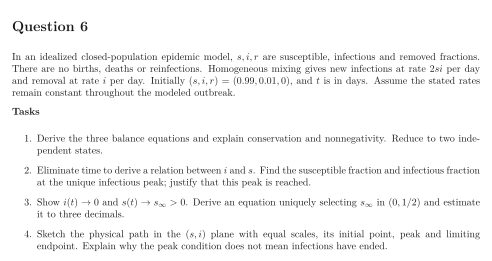
Show solutionHide solution
Question 6 – Solution
Strategy. Conservation confines the dynamics; eliminating time gives an exact curve and identifies both the peak and final-size constraint.
Step 1: Balance the three populations. The equations are , with . Boundary rates cannot create negative fractions. More explicitly, and are positive at finite times; . Use to reduce the system.
Step 2: Eliminate time and locate the peak. Since , . Integrating through the initial point gives Here changes sign at . This value must be reached: if forever, then and , a contradiction. Strict decrease of permits only one crossing. Hence .
Step 3: Identify the physical final size. Because , . Thus decreasing has a positive limit. Also is integrable and has a bounded derivative on the invariant simplex, so : nonvanishing peaks would have widths bounded below and contradict integrability. The peak crossing implies . Substitution gives On the left side is strictly increasing, tends to at zero and is positive at , so this root is unique.
Step 4: Interpret the physical trajectory. Time moves toward smaller , up to the peak and then down toward zero infectious fraction. The limiting endpoint is open because at finite times. At the peak, incidence and removal balance; both are positive. The peak marks zero net infectious growth, not the end of infection.
See the diagram in the original worksheet below.
