Question 4
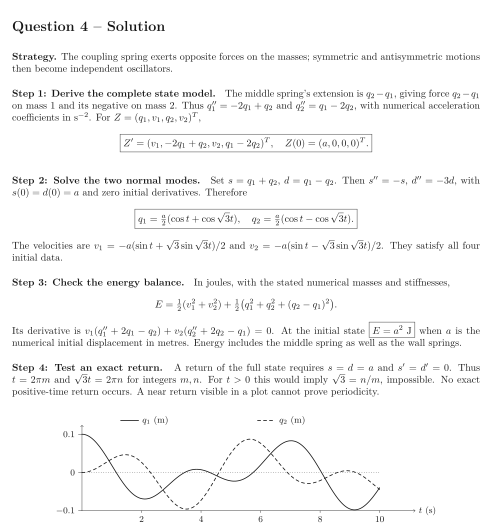
Two kg masses slide without friction on a horizontal line. Each is attached to its outer fixed wall by a spring of stiffness N/m, and a third spring of stiffness N/m joins the masses. Let be displacements in metres from equilibrium, positive to the right. Initially , and both velocities vanish, where . Time is in seconds; Hooke’s law applies.
Tasks
Derive the forces, paying attention to the change in length of the middle spring. Write a first-order system with four states and its initial vector.
Use the sum and difference of the displacements to solve for and their velocities.
Construct the total mechanical energy from the three springs and two masses. Show it is constant and find its initial value.
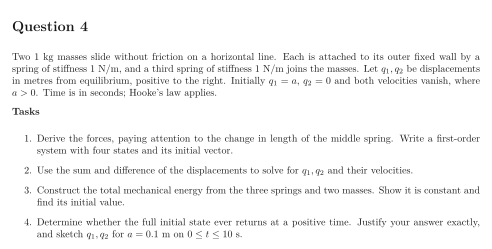
Determine whether the full initial state ever returns at a positive time. Justify your answer exactly, and sketch for m on s.
Show solutionHide solution
Question 4 – Solution
Strategy. The coupling spring exerts opposite forces on the masses; symmetric and antisymmetric motions then become independent oscillators.
Step 1: Derive the complete state model. The middle spring’s extension is , giving force on mass 1 and its negative on mass 2. Thus and , with numerical acceleration coefficients in s. For ,
Step 2: Solve the two normal modes. Set , . Then , , with and zero initial derivatives. Therefore The velocities are and . They satisfy all four initial data.
Step 3: Check the energy balance. In joules, with the stated numerical masses and stiffnesses, Its derivative is . At the initial state when is the numerical initial displacement in metres. Energy includes the middle spring as well as the wall springs.
Step 4: Test an exact return. A return of the full state requires and . Thus and for integers . For this would imply , impossible. No exact positive-time return occurs. A near return visible in a plot cannot prove periodicity.
See the diagram in the original worksheet below.