Question 2
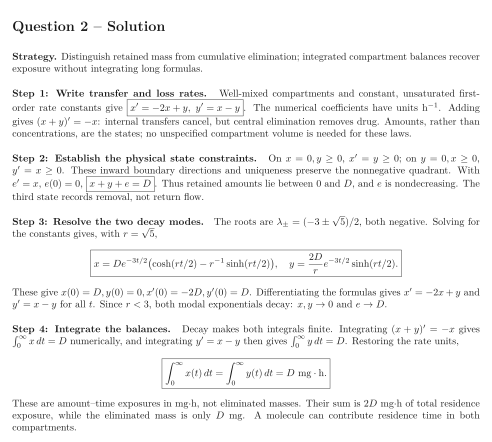
An idealized drug model has a central compartment and a peripheral compartment. Let be drug amounts in mg, with time in hours. Each hour, transfer from central to peripheral is times the current central amount; reverse transfer is times the peripheral amount. Elimination occurs only from the central compartment, at rate times its amount per hour. Immediately after a bolus, , where is the numerical dose in mg; no further drug enters.
Tasks
Derive the two amount equations and the rate of change of total drug. State which modeling assumptions justify linear transfer laws.
Explain why nonnegative initial amounts remain nonnegative. Add an eliminated-drug state and find the conserved total, with .
Solve the two-compartment IVP exactly in terms of . Verify the initial data and determine the limiting retained and eliminated amounts.
Find and directly from the balance equations. Explain their units and why adding them does not count an eliminated mass twice.
Show solutionHide solution
Question 2 – Solution
Strategy. Distinguish retained mass from cumulative elimination; integrated compartment balances recover exposure without integrating long formulas.
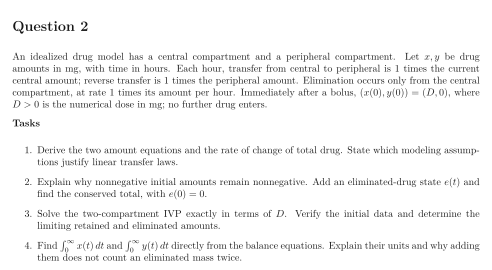
Step 1: Write transfer and loss rates. Well-mixed compartments and constant, unsaturated first-order rate constants give . The numerical coefficients have units h. Adding gives : internal transfers cancel, but central elimination removes drug. Amounts, rather than concentrations, are the states; no unspecified compartment volume is needed for these laws.
Step 2: Establish the physical state constraints. On , ; on , . These inward boundary directions and uniqueness preserve the nonnegative quadrant. With , , . Thus retained amounts lie between and , and is nondecreasing. The third state records removal, not return flow.
Step 3: Resolve the two decay modes. The roots are , both negative. Solving for the constants gives, with , These give . Differentiating the formulas gives and for all . Since , both modal exponentials decay: and .
Step 4: Integrate the balances. Decay makes both integrals finite. Integrating gives numerically, and integrating then gives . Restoring the rate units, These are amount–time exposures in mgh, not eliminated masses. Their sum is mgh of total residence exposure, while the eliminated mass is only mg. A molecule can contribute residence time in both compartments.