Question 10
Work over the real numbers. Use substitution or elimination, keeping track of conditions under which an operation preserves all solutions. Check candidates in the original equations.
Three nonnegative production amounts satisfy two exact resource totals: The return is . Fractional production amounts are permitted.
Tasks
Find all solutions of the two equalities, then determine the exact parameter interval allowed by nonnegativity.
Find the minimum and maximum return over the feasible set, giving every allocation at which either is attained.
Add the capacity constraint . Find the new feasible set and the new maximizing allocation and return.
Explain why solving the equalities alone does not solve the allocation problem. Verify the optimizing allocations against both original totals and all applicable inequalities.
Show solutionHide solution
Question 10 – Solution
Strategy. Solve the equalities first, then optimize over the remaining feasible interval rather than over an unrestricted algebraic family.
Step 1: Parameterize and restrict. Subtract the first equality from the second to obtain . Set , giving Nonnegativity imposes , and . The complete feasible set is therefore Each member satisfies both original totals; every feasible member must arise from this parameterization.
Step 2: Optimize on the feasible interval. The return becomes . It is strictly increasing, so the unique minimum is at , and the unique maximum is at . Neither an interior stationary-point calculation nor an integer search is needed; the stated amounts may be fractional.
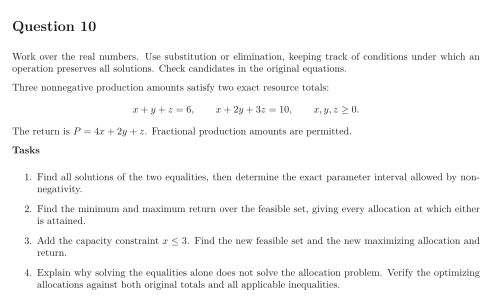
Step 3: Include the new capacity. The constraint becomes , or . The new feasible interval is , with unique maximizing allocation The minimum remains at . In the figure, the feasible sets are shown in the plane; is determined by the equalities.
Step 4: Verify the optimizers and the role of inequalities. The endpoint triples and have totals and are nonnegative. The new optimizer also has totals and satisfies . The former maximizer has , so it is no longer allowed. Over the unrestricted equality family, has no finite maximum or minimum. The inequalities make the allowed interval bounded and turn this into a well-posed allocation problem.
See the diagram in the original worksheet below.