Question 1
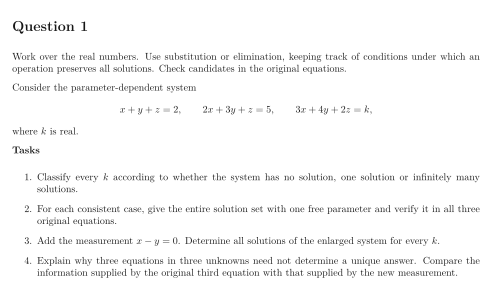
Work over the real numbers. Use substitution or elimination, keeping track of conditions under which an operation preserves all solutions. Check candidates in the original equations.
Consider the parameter-dependent system where is real.
Tasks
Classify every according to whether the system has no solution, one solution or infinitely many solutions.
For each consistent case, give the entire solution set with one free parameter and verify it in all three original equations.
Add the measurement . Determine all solutions of the enlarged system for every .
Explain why three equations in three unknowns need not determine a unique answer. Compare the information supplied by the original third equation with that supplied by the new measurement.
Show solutionHide solution
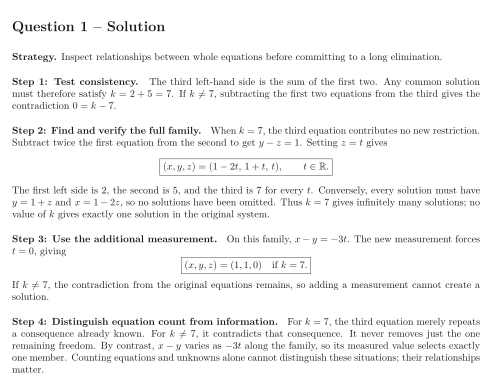
Question 1 – Solution
Strategy. Inspect relationships between whole equations before committing to a long elimination.
Step 1: Test consistency. The third left-hand side is the sum of the first two. Any common solution must therefore satisfy . If , subtracting the first two equations from the third gives the contradiction .
Step 2: Find and verify the full family. When , the third equation contributes no new restriction. Subtract twice the first equation from the second to get . Setting gives The first left side is , the second is , and the third is for every . Conversely, every solution must have and , so no solutions have been omitted. Thus gives infinitely many solutions; no value of gives exactly one solution in the original system.
Step 3: Use the additional measurement. On this family, . The new measurement forces , giving If , the contradiction from the original equations remains, so adding a measurement cannot create a solution.
Step 4: Distinguish equation count from information. For , the third equation merely repeats a consequence already known. For , it contradicts that consequence. It never removes just the one remaining freedom. By contrast, varies as along the family, so its measured value selects exactly one member. Counting equations and unknowns alone cannot distinguish these situations; their relationships matter.