Question 2
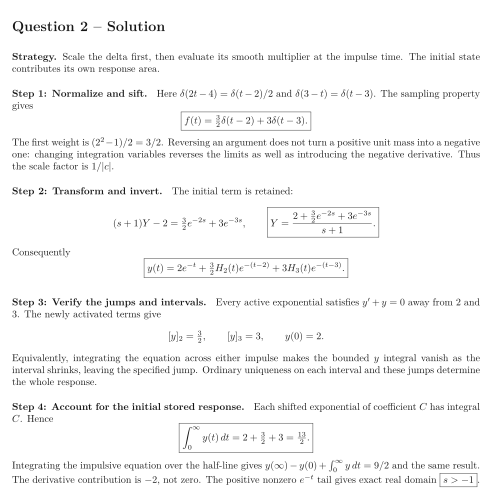
Use causal one-sided Laplace transforms. Write for and for . The unit impulse satisfies for continuous near . Interpret equations between impulses and through their jump conditions; use right-hand values at jumps. Write for a jump.
Consider a weighted impulse and a reversed impulse argument: You may use for .
Tasks
Reduce the forcing to impulses at named times with constant weights. Explain the absolute value in the scaling rule.
Find and the complete time response, including the initial state.
Determine both jumps and verify the ordinary equation on each interval.
Compute the response area and its exact real transform domain. Explain why the response area is not just the sum of the impulse weights.
Show solutionHide solution
Question 2 – Solution
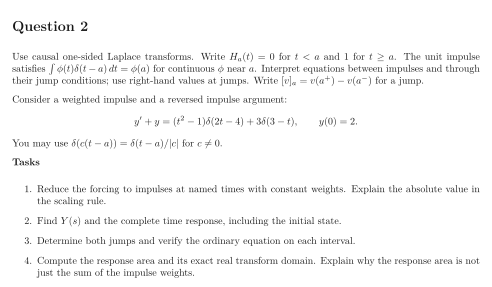
Strategy. Scale the delta first, then evaluate its smooth multiplier at the impulse time. The initial state contributes its own response area.
Step 1: Normalize and sift. Here and . The sampling property gives The first weight is . Reversing an argument does not turn a positive unit mass into a negative one: changing integration variables reverses the limits as well as introducing the negative derivative. Thus the scale factor is .
Step 2: Transform and invert. The initial term is retained: Consequently
Step 3: Verify the jumps and intervals. Every active exponential satisfies away from and . The newly activated terms give Equivalently, integrating the equation across either impulse makes the bounded integral vanish as the interval shrinks, leaving the specified jump. Ordinary uniqueness on each interval and these jumps determine the whole response.
Step 4: Account for the initial stored response. Each shifted exponential of coefficient has integral . Hence Integrating the impulsive equation over the half-line gives and the same result. The derivative contribution is , not zero. The positive nonzero tail gives exact real domain .