Question 1
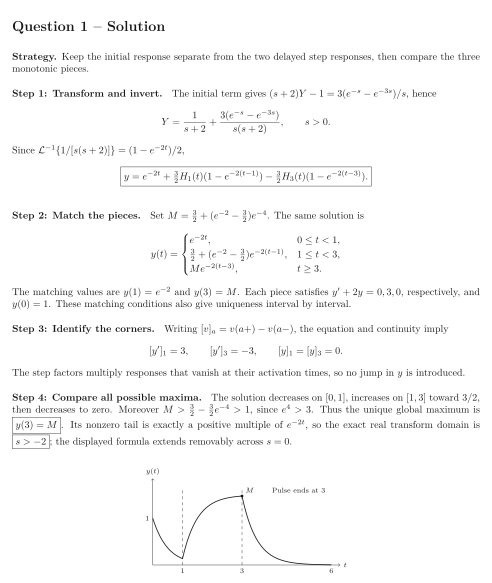
Let for and for . Use one-sided Laplace transforms. Solutions are continuous (and have continuous first derivative for second-order equations); satisfy the equation away from switches and use one-sided derivatives there. Isolated input values do not change the solution.
A first-order system starts above zero and receives a finite pulse:
Tasks
Find and invert it in step-function form, retaining the initial response.
Write the solution on the three time intervals and verify the equation and matching values.
Find the jumps in at both switches. Explain whether jumps.
Locate the global maximum on , prove it is global, and state the exact real transform domain.
Show solutionHide solution
Question 1 – Solution
Strategy. Keep the initial response separate from the two delayed step responses, then compare the three monotonic pieces.
Step 1: Transform and invert. The initial term gives , hence Since ,
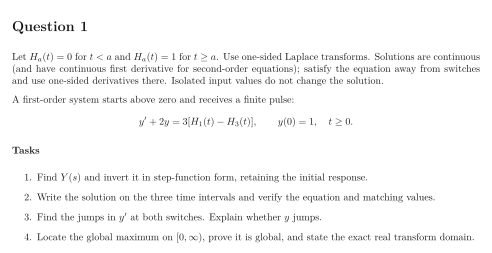
Step 2: Match the pieces. Set . The same solution is The matching values are and . Each piece satisfies , respectively, and . These matching conditions also give uniqueness interval by interval.
Step 3: Identify the corners. Writing , the equation and continuity imply The step factors multiply responses that vanish at their activation times, so no jump in is introduced.
Step 4: Compare all possible maxima. The solution decreases on , increases on toward , then decreases to zero. Moreover , since . Thus the unique global maximum is . Its nonzero tail is exactly a positive multiple of , so the exact real transform domain is ; the displayed formula extends removably across .
See the diagram in the original worksheet below.