Question 10
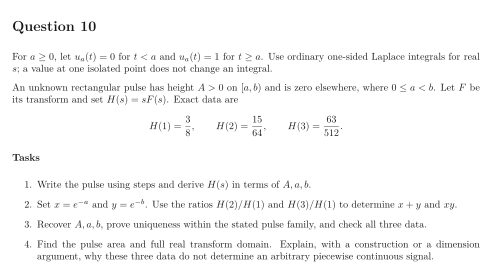
For , let for and for . Use ordinary one-sided Laplace integrals for real ; a value at one isolated point does not change an integral.
An unknown rectangular pulse has height on and is zero elsewhere, where . Let be its transform and set . Exact data are
Tasks
Write the pulse using steps and derive in terms of .
Set and . Use the ratios and to determine and .
Recover , prove uniqueness within the stated pulse family, and check all three data.
Find the pulse area and full real transform domain. Explain, with a construction or a dimension argument, why these three data do not determine an arbitrary piecewise continuous signal.
Show solutionHide solution
Question 10 – Solution
Strategy. Consecutive exponential measurements determine symmetric functions of the two endpoints. The ordering of the endpoints then removes the root ambiguity.
Step 1: Encode the window. The pulse is . Integrating on its finite support gives With and , the restrictions become .
Step 2: Recover the two symmetric quantities. Since , Therefore . The numbers are the roots of .
Step 3: Order the roots and find the height. The roots are and . The condition gives Both endpoint restrictions hold. Direct checks yield , and . The two roots, their ordering and the nonzero first measurement fix all three parameters, proving uniqueness within this family.
Step 4: State what the data do and do not determine. The area is . Finite support gives convergence for every real , with zero removable in the displayed formula. To see the limitation of three measurements, take four disjoint unit pulses on , . Requiring their linear combination to have zero transform at gives three homogeneous linear equations in four coefficients. A nonzero coefficient vector exists; disjoint supports make its signal nonzero. Adding it preserves all three data but changes the original signal. This signed perturbation need not belong to the rectangular family, so it does not contradict the uniqueness just proved.
See the diagram in the original worksheet below.
