Question 1
For , let for and for . Use ordinary one-sided Laplace integrals for real ; a value at one isolated point does not change an integral.
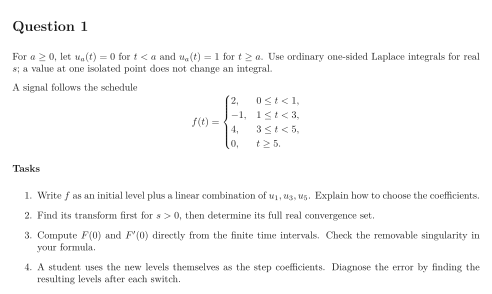
A signal follows the schedule
Tasks
Write as an initial level plus a linear combination of . Explain how to choose the coefficients.
Find its transform first for , then determine its full real convergence set.
Compute and directly from the finite time intervals. Check the removable singularity in your formula.
A student uses the new levels themselves as the step coefficients. Diagnose the error by finding the resulting levels after each switch.
Show solutionHide solution
Question 1 – Solution
Strategy. A step adds a change to the existing level; it does not replace that level. Compact support must be assessed after the changes are combined.
Step 1: Encode the changes. The changes at times one, three and five are . Therefore The convention gives the prescribed value at every switch. Successively subtracting adjacent levels determines these coefficients uniquely for the specified switch times.
Step 2: Transform and check support. For , by direct integration from to infinity. Thus Although the separate step integrals require , the actual signal vanishes after five. Integrating on its three finite intervals proves the same formula for every real ; the original integral exists for every real .
Step 3: Evaluate the removable value and first moment. Directly, Finite support justifies differentiation under the integral. Expanding the numerator gives , so , confirming both results. Zero is removable, not a divergent transform point.
Step 4: Diagnose replacement versus addition. The mistaken expression produces levels . It neither reaches the intended levels nor shuts off. Each step must carry the difference between the new and old levels. The graph uses open and filled endpoints to record the specified right-hand values.
See the diagram in the original worksheet below.
