Question 2
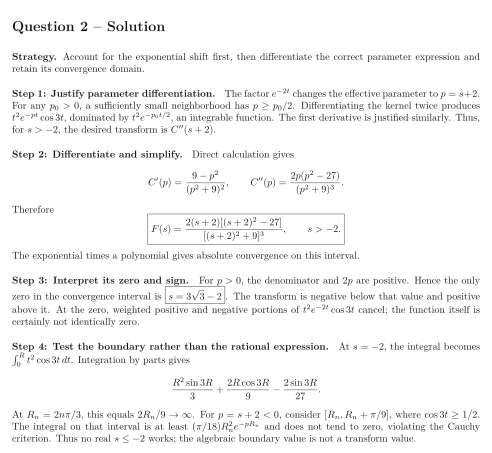
For real , write where the integral converges.
Find the transform of by combining exponential shifting with differentiation in the transform parameter. You may use for .
Tasks
Justify the identity in this example, including the convergence condition needed for differentiation.
Compute and simplify the transform explicitly.
Find all its zeros and determine its sign within the convergence interval. Explain why a zero transform value need not mean that the original function is zero.
The simplified expression also has value zero at . Does that value represent an ordinary Laplace integral? Check the boundary directly and determine whether any smaller real parameter can work.
Show solutionHide solution
Question 2 – Solution
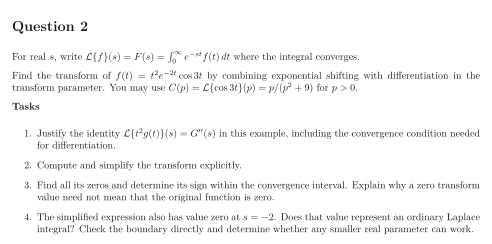
Strategy. Account for the exponential shift first, then differentiate the correct parameter expression and retain its convergence domain.
Step 1: Justify parameter differentiation. The factor changes the effective parameter to . For any , a sufficiently small neighborhood has . Differentiating the kernel twice produces , dominated by , an integrable function. The first derivative is justified similarly. Thus, for , the desired transform is .
Step 2: Differentiate and simplify. Direct calculation gives Therefore The exponential times a polynomial gives absolute convergence on this interval.
Step 3: Interpret its zero and sign. For , the denominator and are positive. Hence the only zero in the convergence interval is . The transform is negative below that value and positive above it. At the zero, weighted positive and negative portions of cancel; the function itself is certainly not identically zero.
Step 4: Test the boundary rather than the rational expression. At , the integral becomes . Integration by parts gives At , this equals . For , consider , where . The integral on that interval is at least and does not tend to zero, violating the Cauchy criterion. Thus no real works; the algebraic boundary value is not a transform value.