Question 1
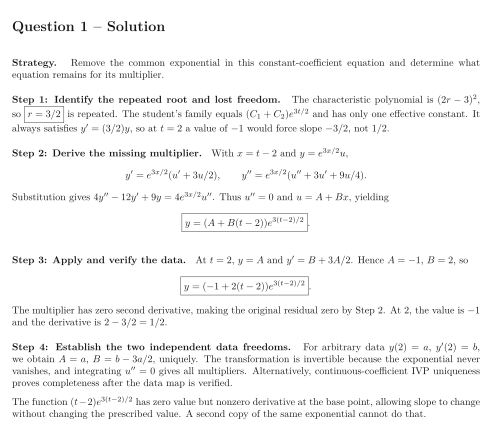
Consider A student proposes as the general solution because the characteristic root occurs twice.
Tasks
Find the characteristic root and explain precisely which initial-data freedom the proposed family lacks.
Put and . Differentiate to reduce this particular equation to an equation for , and obtain the full solution family.
Fit the initial data and verify the resulting solution in the original equation and both data.
Show that the derived family can represent arbitrary value and slope at . Justify completeness and explain why multiplying one exponential by creates a new freedom while merely naming a second coefficient does not.
Show solutionHide solution
Question 1 – Solution
Strategy. Remove the common exponential in this constant-coefficient equation and determine what equation remains for its multiplier.
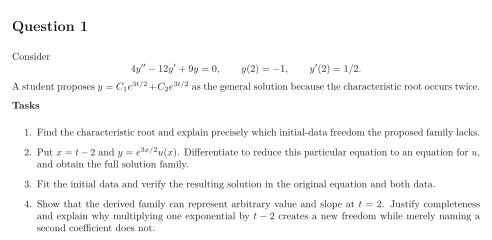
Step 1: Identify the repeated root and lost freedom. The characteristic polynomial is , so is repeated. The student’s family equals and has only one effective constant. It always satisfies , so at a value of would force slope , not .
Step 2: Derive the missing multiplier. With and , Substitution gives . Thus and , yielding
Step 3: Apply and verify the data. At , and . Hence , , so The multiplier has zero second derivative, making the original residual zero by Step 2. At 2, the value is and the derivative is .
Step 4: Establish the two independent data freedoms. For arbitrary data , , we obtain , , uniquely. The transformation is invertible because the exponential never vanishes, and integrating gives all multipliers. Alternatively, continuous-coefficient IVP uniqueness proves completeness after the data map is verified.
The function has zero value but nonzero derivative at the base point, allowing slope to change without changing the prescribed value. A second copy of the same exponential cannot do that.