Question 9
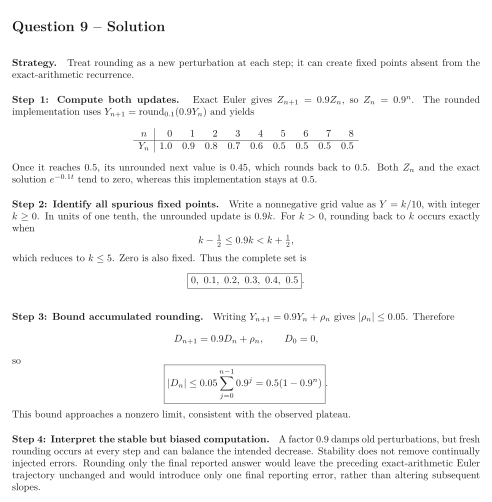
Consider , , with Euler step . Let be the exact-arithmetic Euler sequence. A second implementation rounds each new value to the nearest tenth immediately after each step, calling the result . Use decimal rounding with ties away from zero; in particular, rounds to . Assume the stated decimal rule is applied exactly, rather than relying on binary floating-point tie behavior.
Tasks
Derive the exact-arithmetic and rounded recurrences. Tabulate for and compare its eventual behavior with and the exact solution.
Find every nonnegative multiple of that is a fixed point of the rounded update.
Writing each rounding error as , derive an error recurrence for and prove .
Explain why a stable Euler amplification factor does not force a repeatedly rounded computation to converge to the true equilibrium. Distinguish rounding at every step from rounding only the reported final answer.
Show solutionHide solution
Question 9 – Solution
Strategy. Treat rounding as a new perturbation at each step; it can create fixed points absent from the exact-arithmetic recurrence.
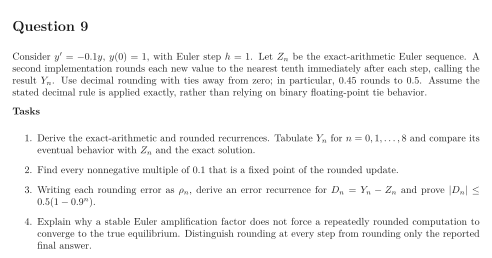
Step 1: Compute both updates. Exact Euler gives , so . The rounded implementation uses and yields Once it reaches , its unrounded next value is , which rounds back to . Both and the exact solution tend to zero, whereas this implementation stays at .
Step 2: Identify all spurious fixed points. Write a nonnegative grid value as , with integer . In units of one tenth, the unrounded update is . For , rounding back to occurs exactly when which reduces to . Zero is also fixed. Thus the complete set is
Step 3: Bound accumulated rounding. Writing gives . Therefore so This bound approaches a nonzero limit, consistent with the observed plateau.
Step 4: Interpret the stable but biased computation. A factor damps old perturbations, but fresh rounding occurs at every step and can balance the intended decrease. Stability does not remove continually injected errors. Rounding only the final reported answer would leave the preceding exact-arithmetic Euler trajectory unchanged and would introduce only one final reporting error, rather than altering subsequent slopes.