Question 7
Consider the continuous, non-Lipschitz equation When solutions are not unique, call an equilibrium stable only if every forward solution from every sufficiently close initial value remains within any prescribed neighborhood.
Tasks
Find all equilibria and determine the sign of the right-hand side away from them.
For each , construct a solution that stays at zero through time and then becomes positive. Verify differentiability at the joining time.
Construct a continuously differentiable solution with that crosses the equilibrium level at , and sketch it.
Prove that the equilibrium is unstable under the stated convention. Explain precisely why the usual prohibition against crossing an equilibrium does not apply.
Show solutionHide solution
Question 7 – Solution
Strategy. Verify explicit joined solutions instead of invoking a uniqueness theorem whose hypothesis fails.
Step 1: Find the zero and signs. The only equilibrium is . The right-hand side is positive for every , so motion is upward on either side. Below zero the direction is toward the equilibrium level, but arrival need not force the solution to stay there.
Step 2: Verify delayed departures. For any , define Before both sides of the equation vanish; afterward . At , both values and both one-sided derivatives are zero. The difference quotient also gives derivative zero, so the joined solution is continuously differentiable. The identically zero function is another solution.
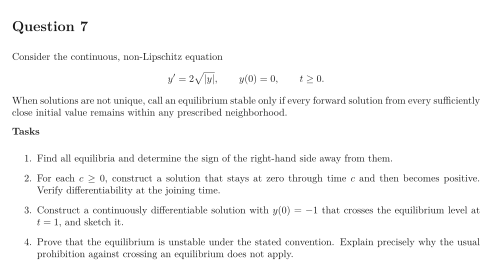
Step 3: Cross from below. A crossing solution is Before , ; afterward the same check as above applies. Both derivatives at the join are zero, and .
See the diagram in the original worksheet below.
Step 4: Diagnose instability and failed uniqueness. For any , initial value is within of the equilibrium, yet the solution leaves the fixed neighborhood after . This violates the stated requirement for every forward solution, so the equilibrium is unstable.
Local Lipschitz regularity fails since is unbounded near zero. The crossing and constant solutions agree at but have different continuations. The usual noncrossing proof requires local uniqueness; continuity alone does not provide it.