Question 10
A reservoir initially contains L of usable liquid. During a four-minute operation, a pump supplies a constant rate L/min, scheduled demand removes liquid at rate L/min, and leakage removes liquid at a rate equal to times the current volume per minute. Here is in minutes; the slope in is L/min.
The reservoir must retain at least L at every time . Assume no capacity restriction, no other flows, and that the stated demand and leakage laws apply while liquid remains.
Tasks
Derive and solve the volume IVP in terms of .
Find the smallest constant pump rate that satisfies the reserve requirement throughout the operation. Justify feasibility over the whole interval, not only at its endpoint.
For this rate, calculate the cumulative leaked volume by using an overall volume balance.
Compare the answer with the minimum pump rate obtained by ignoring leakage. Sketch the optimal volume and reserve level, and explain why the no-leakage design cannot meet the original requirement.
Show solutionHide solution
Question 10 – Solution
Strategy. Solve the storage balance, obtain a necessary pump rate from the final reserve, and then verify that this candidate satisfies the full time constraint.
Step 1: Model and solve the storage balance. Input minus demand minus leakage gives with all rates in L/min. A particular solution is ; adding and applying gives It has initial value , and differentiation gives the required balance on any time interval on which the physical operation remains valid.
Step 2: Find and verify the minimum rate. Since is necessary, For this candidate, and Thus decreases from to exactly L and never violates the reserve. The candidate is feasible, and every smaller rate fails the necessary final condition, proving optimality.
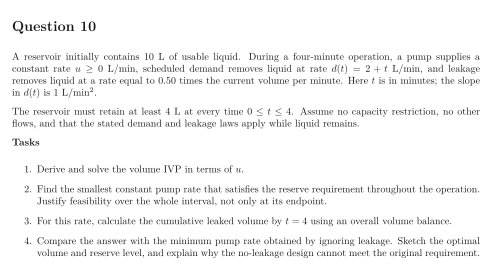
See the diagram in the original worksheet below.
Step 3: Recover cumulative leakage. The scheduled demand totals L. Initial storage plus pumped volume equals final storage plus demand plus leakage, so
Step 4: Compare the incomplete model. Ignoring leakage gives . This concave function has its minimum on at an endpoint; gives the no-leakage minimum L/min. That rate is below and fails the actual reserve constraint. It may eventually exhaust the actual reservoir, so negative values of its unconstrained storage formula would not describe physical stored liquid. The optimal design above stays positive and avoids that limitation.