Question 8
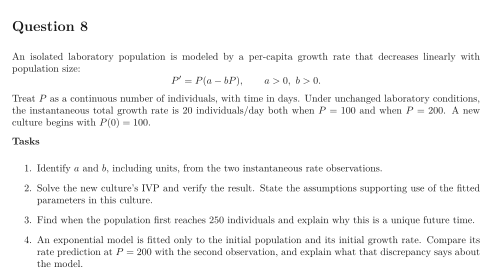
An isolated laboratory population is modeled by a per-capita growth rate that decreases linearly with population size: Treat as a continuous number of individuals, with time in days. Under unchanged laboratory conditions, the instantaneous total growth rate is individuals/day both when and when . A new culture begins with .
Tasks
Identify and , including units, from the two instantaneous rate observations.
Solve the new culture’s IVP and verify the result. State the assumptions supporting use of the fitted parameters in this culture.
Find when the population first reaches individuals and explain why this is a unique future time.
An exponential model is fitted only to the initial population and its initial growth rate. Compare its rate prediction at with the second observation, and explain what that discrepancy says about the model.
Show solutionHide solution
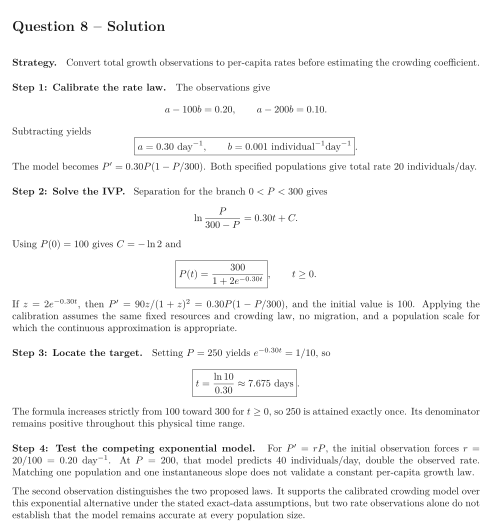
Question 8 – Solution
Strategy. Convert total growth observations to per-capita rates before estimating the crowding coefficient.
Step 1: Calibrate the rate law. The observations give Subtracting yields The model becomes . Both specified populations give total rate individuals/day.
Step 2: Solve the IVP. Separation for the branch gives Using gives and If , then , and the initial value is . Applying the calibration assumes the same fixed resources and crowding law, no migration, and a population scale for which the continuous approximation is appropriate.
Step 3: Locate the target. Setting yields , so The formula increases strictly from toward for , so is attained exactly once. Its denominator remains positive throughout this physical time range.
Step 4: Test the competing exponential model. For , the initial observation forces day. At , that model predicts individuals/day, double the observed rate. Matching one population and one instantaneous slope does not validate a constant per-capita growth law.
The second observation distinguishes the two proposed laws. It supports the calibrated crowding model over this exponential alternative under the stated exact-data assumptions, but two rate observations alone do not establish that the model remains accurate at every population size.