Question 4
A kg test package is released from rest. Take downward as positive and use m/s. Model drag as a force opposing its downward velocity . Before a parachute opens at s, kg/s; afterward, kg/s. Assume the opening changes the drag coefficient instantly but delivers no impulse, and the package remains airborne through s.
Tasks
Derive the velocity equation in each phase from Newton’s second law. State the initial and matching conditions.
Solve for through s and calculate the velocity immediately before and after opening.
Find the total downward distance traveled during the first s.
Find the one-sided accelerations at opening and sketch the velocity. Explain why velocity is continuous although acceleration jumps, and state where a classical phase equation applies.
Show solutionHide solution
Question 4 – Solution
Strategy. Balance forces in each phase and carry velocity continuously across a coefficient change; integrate velocity to obtain displacement.
Step 1: Model and match the phases. Newton’s law gives , with forces in newtons. Thus before opening and afterward. The initial value is , and no impulse means .
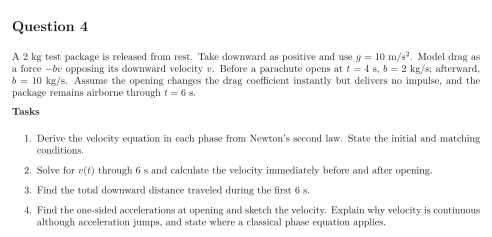
Step 2: Solve both initial-value problems. The solutions are Each expression satisfies its phase equation, and both give at the switch. The phase terminal speeds are and m/s, respectively.
Step 3: Integrate the distance. Velocity stays positive, so downward displacement equals distance traveled: The first term integrates the pre-opening velocity over ; the remaining terms integrate the post-opening velocity over .
See the diagram in the original worksheet below.
Step 4: Examine the acceleration jump. The one-sided accelerations are Changing a finite force changes acceleration without an instantaneous velocity jump. The velocity is continuous and piecewise differentiable, but is not differentiable at the idealized switch. Each classical phase equation applies away from ; the switch is handled by continuity, not by requiring a single derivative there.