Question 1
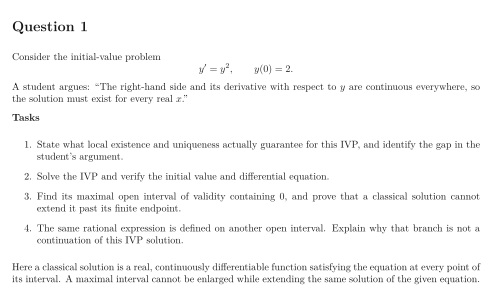
Consider the initial-value problem A student argues: “The right-hand side and its derivative with respect to are continuous everywhere, so the solution must exist for every real .”
Tasks
State what local existence and uniqueness actually guarantee for this IVP, and identify the gap in the student’s argument.
Solve the IVP and verify the initial value and differential equation.
Find its maximal open interval of validity containing , and prove that a classical solution cannot extend it past its finite endpoint.
The same rational expression is defined on another open interval. Explain why that branch is not a continuation of this IVP solution.
Here a classical solution is a real, continuously differentiable function satisfying the equation at every point of its interval. A maximal interval cannot be enlarged while extending the same solution of the given equation.
Show solutionHide solution
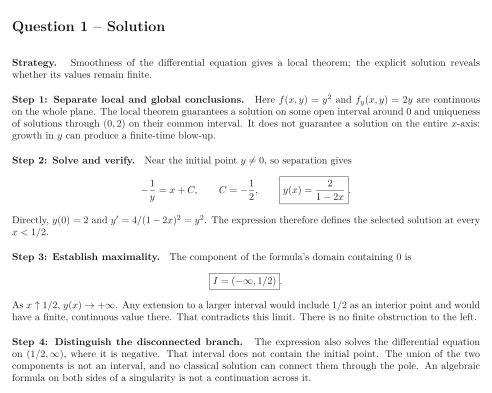
Question 1 – Solution
Strategy. Smoothness of the differential equation gives a local theorem; the explicit solution reveals whether its values remain finite.
Step 1: Separate local and global conclusions. Here and are continuous on the whole plane. The local theorem guarantees a solution on some open interval around and uniqueness of solutions through on their common interval. It does not guarantee a solution on the entire -axis: growth in can produce a finite-time blow-up.
Step 2: Solve and verify. Near the initial point , so separation gives Directly, and . The expression therefore defines the selected solution at every .
Step 3: Establish maximality. The component of the formula’s domain containing is As , . Any extension to a larger interval would include as an interior point and would have a finite, continuous value there. That contradicts this limit. There is no finite obstruction to the left.
Step 4: Distinguish the disconnected branch. The expression also solves the differential equation on , where it is negative. That interval does not contain the initial point. The union of the two components is not an interval, and no classical solution can connect them through the pole. An algebraic formula on both sides of a singularity is not a continuation across it.