Question 4
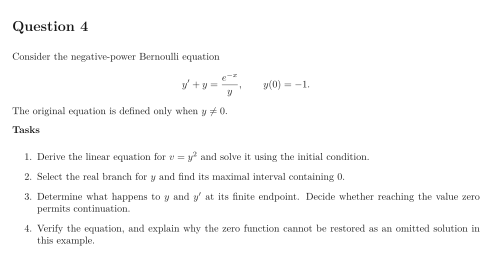
Consider the negative-power Bernoulli equation The original equation is defined only when .
Tasks
Derive the linear equation for and solve it using the initial condition.
Select the real branch for and find its maximal interval containing .
Determine what happens to and at its finite endpoint. Decide whether reaching the value zero permits continuation.
Verify the equation, and explain why the zero function cannot be restored as an omitted solution in this example.
Show solutionHide solution
Question 4 – Solution
Strategy. The squared variable must be strictly positive, and the original reciprocal term remains undefined at zero.
Step 1: Linearize and integrate. Multiplication by yields , where . Using the integrating factor , Since , .
Step 2: Invert on the correct interval. The condition requires . The initial sign gives As , from below. The equation gives , so no differentiable extension exists at that endpoint. Also the original right-hand side is undefined there. As , from below, but it never reaches zero at a finite point of .
Step 3: Verify and check the excluded value. Differentiating gives . Since and on , division by recovers . The selected formula gives . Unlike positive-power examples, : the original equation has no value at zero.
See the diagram in the original worksheet below.
