Question 6
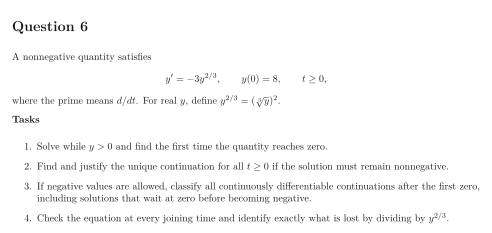
A nonnegative quantity satisfies where the prime means . For real , define .
Tasks
Solve while and find the first time the quantity reaches zero.
Find and justify the unique continuation for all if the solution must remain nonnegative.
If negative values are allowed, classify all continuously differentiable continuations after the first zero, including solutions that wait at zero before becoming negative.
Check the equation at every joining time and identify exactly what is lost by dividing by .
Show solutionHide solution
Question 6 – Solution
Strategy. Separate only where , then use the sign of and check any joins at zero directly.
Step 1: Reach zero. While , integration gives . The data yield for , so the first zero is .
Step 2: Enforce nonnegativity. The equation always gives . Once a nonnegative solution reaches zero it cannot increase or decrease without violating that constraint. Thus the unique nonnegative continuation is up to , followed by forever.
Step 3: Classify real continuations. For any finite , a real continuation is Also allow , meaning the solution stays zero forever. These exhaust the possibilities: monotonicity makes the zero set after an interval; once negative, separation gives , where continuity fixes the constant at the departure time .
Step 4: Verify the joins and the lost solutions. Each cubic piece has . At and any finite , both one-sided derivatives are , matching the equation at . The pieces are therefore . Division excludes zero itself, so it misses the constant zero solution and all zero waiting intervals; using one integration constant through zero is unjustified.
See the diagram in the original worksheet below.
