Question 2
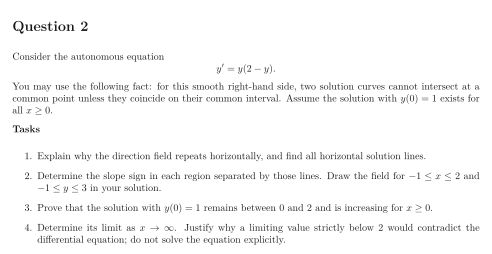
Consider the autonomous equation You may use the following fact: for this smooth right-hand side, two solution curves cannot intersect at a common point unless they coincide on their common interval. Assume the solution with exists for all .
Tasks
Explain why the direction field repeats horizontally, and find all horizontal solution lines.
Determine the slope sign in each region separated by those lines. Draw the field for and in your solution.
Prove that the solution with remains between and and is increasing for .
Determine its limit as . Justify why a limiting value strictly below would contradict the differential equation; do not solve the equation explicitly.
Show solutionHide solution
Question 2 – Solution
Strategy. Read the signs between horizontal zero-slope lines, then use nonintersection and a bounded-monotone argument.
Step 1: Field structure. The slope depends only on , so it is the same along every horizontal row. Constant solutions require , giving . The sign is negative for , positive for , and negative for .
See the diagram in the original worksheet below.
Step 2: Confinement and monotonicity. Starting at , a continuous solution could leave only by meeting one of the equilibrium solutions. The stated nonintersection fact excludes this. Therefore Since , the function is bounded below by on this half-line.
Step 3: Limit without an explicit formula. An increasing function bounded above by has a limit with . If , continuity of gives and, eventually, . Integrating from a sufficiently large yields contradicting the upper bound . Thus . The limit is approached from below, without touching the equilibrium at any finite .
