Question 1
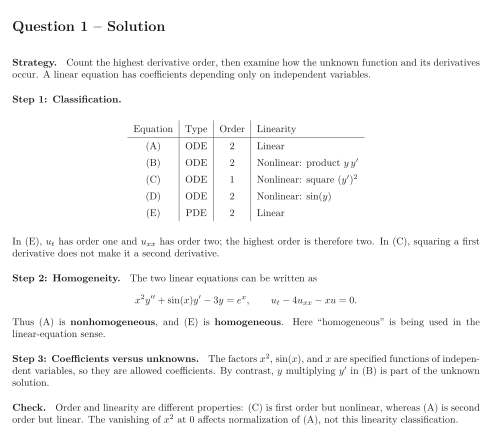
Consider the following equations. In (A)–(D), is a function of ; in (E), is a function of the independent variables and . Tasks
Identify each equation as an ordinary or partial differential equation, and state its order.
Decide whether each equation is linear in its unknown function. For every nonlinear equation, identify the precise obstruction to linearity.
Among the linear equations, identify which are homogeneous after all unknown-function terms are moved to the left.
Explain why the factor in (A) and the factor in (E) do not cause nonlinearity.
Show solutionHide solution
Question 1 – Solution
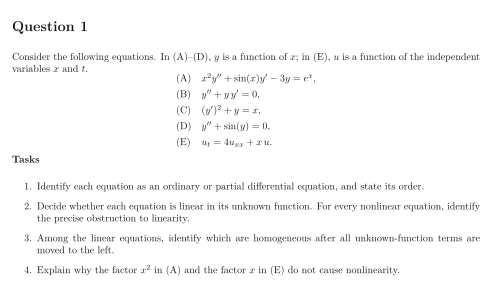
Strategy. Count the highest derivative order, then examine how the unknown function and its derivatives occur. A linear equation has coefficients depending only on independent variables.
Step 1: Classification.
| Equation | Type | Order | Linearity |
|---|---|---|---|
| (A) | ODE | 2 | Linear |
| (B) | ODE | 2 | Nonlinear: product |
| (C) | ODE | 1 | Nonlinear: square |
| (D) | ODE | 2 | Nonlinear: |
| (E) | PDE | 2 | Linear |
In (E), has order one and has order two; the highest order is therefore two. In (C), squaring a first derivative does not make it a second derivative.
Step 2: Homogeneity. The two linear equations can be written as Thus (A) is nonhomogeneous, and (E) is homogeneous. Here “homogeneous” is being used in the linear-equation sense.
Step 3: Coefficients versus unknowns. The factors , , and are specified functions of independent variables, so they are allowed coefficients. By contrast, multiplying in (B) is part of the unknown solution.
Check. Order and linearity are different properties: (C) is first order but nonlinear, whereas (A) is second order but linear. The vanishing of at affects normalization of (A), not this linearity classification.