Question 7
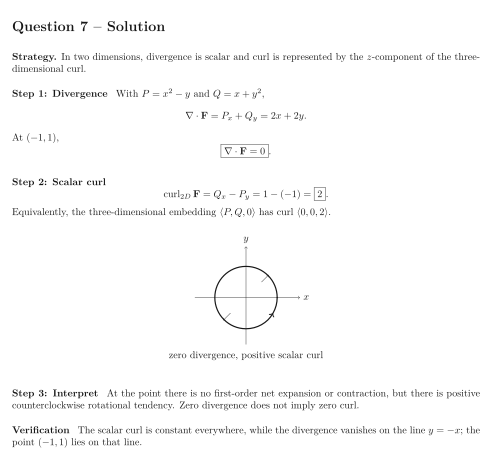
For the planar field compute its planar divergence and scalar curl, then evaluate them at .
Tasks
Compute .
Compute .
Interpret the two values at the specified point.
Show solutionHide solution
Question 7 – Solution
Strategy. In two dimensions, divergence is scalar and curl is represented by the -component of the three-dimensional curl.
Step 1: Divergence With and , At ,
Step 2: Scalar curl Equivalently, the three-dimensional embedding has curl .
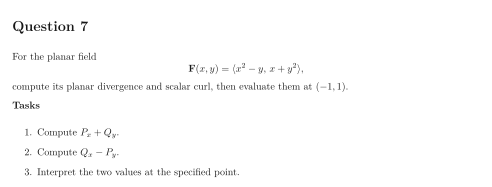
See the diagram in the original worksheet below.
Step 3: Interpret At the point there is no first-order net expansion or contraction, but there is positive counterclockwise rotational tendency. Zero divergence does not imply zero curl.
Verification The scalar curl is constant everywhere, while the divergence vanishes on the line ; the point lies on that line.