Cylindrical Coordinates — Question 2

PDF ↗

Question 2

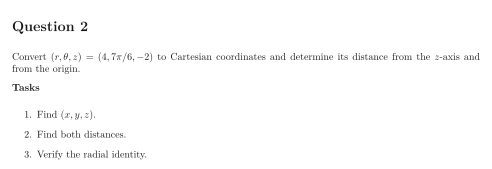
Convert (r,θ,z)=(4,7π/6,−2)(r,\theta,z)=(4,7\pi/6,-2) to Cartesian coordinates and determine its distance from the zz-axis and from the origin.

Tasks

  1. Find (x,y,z)(x,y,z).

  2. Find both distances.

  3. Verify the radial identity.

Original worksheet page 1: question and worked solution for 1-12-002
Show solutionHide solution

Question 2 – Solution

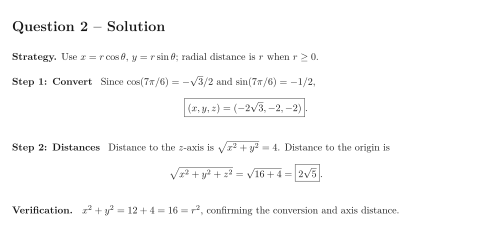
Strategy. Use x=rcos⁡θx=r\cos\theta, y=rsin⁡θy=r\sin\theta; radial distance is rr when r≥0r\ge 0.

Step 1: Convert Since cos⁡(7π/6)=−3/2\cos(7\pi/6)=-\sqrt 3/2 and sin⁡(7π/6)=−1/2\sin(7\pi/6)=-1/2, (x,y,z)=(−23,−2,−2).\boxed{(x,y,z)=(-2\sqrt 3,-2,-2)}.

Step 2: Distances Distance to the zz-axis is x2+y2=4\sqrt{x^2+y^2}=4. Distance to the origin is x2+y2+z2=16+4=25.\sqrt{x^2+y^2+z^2}=\sqrt{16+4}=\boxed{2\sqrt 5}.

Verification. x2+y2=12+4=16=r2x^2+y^2=12+4=16=r^2, confirming the conversion and axis distance.
Original worksheet page 2: question and worked solution for 1-12-002

Original worksheet layout. Use Enlarge or open the PDF for a closer view.